SP Energy Networks
Its Scottish distribution area includes locations such as Glasgow, Edinburgh, Fife, Lanarkshire, Ayrshire, Borders and Dumfries.

The independent homeowner guide
Scotland gets enough daylight for solar to work. That is the easy part.
The harder questions are whether your roof is suitable, how large the system should be, whether a battery makes sense, what your electricity network will allow and whether the numbers still work once the sales assumptions are challenged.
Last reviewed: 1 September 2026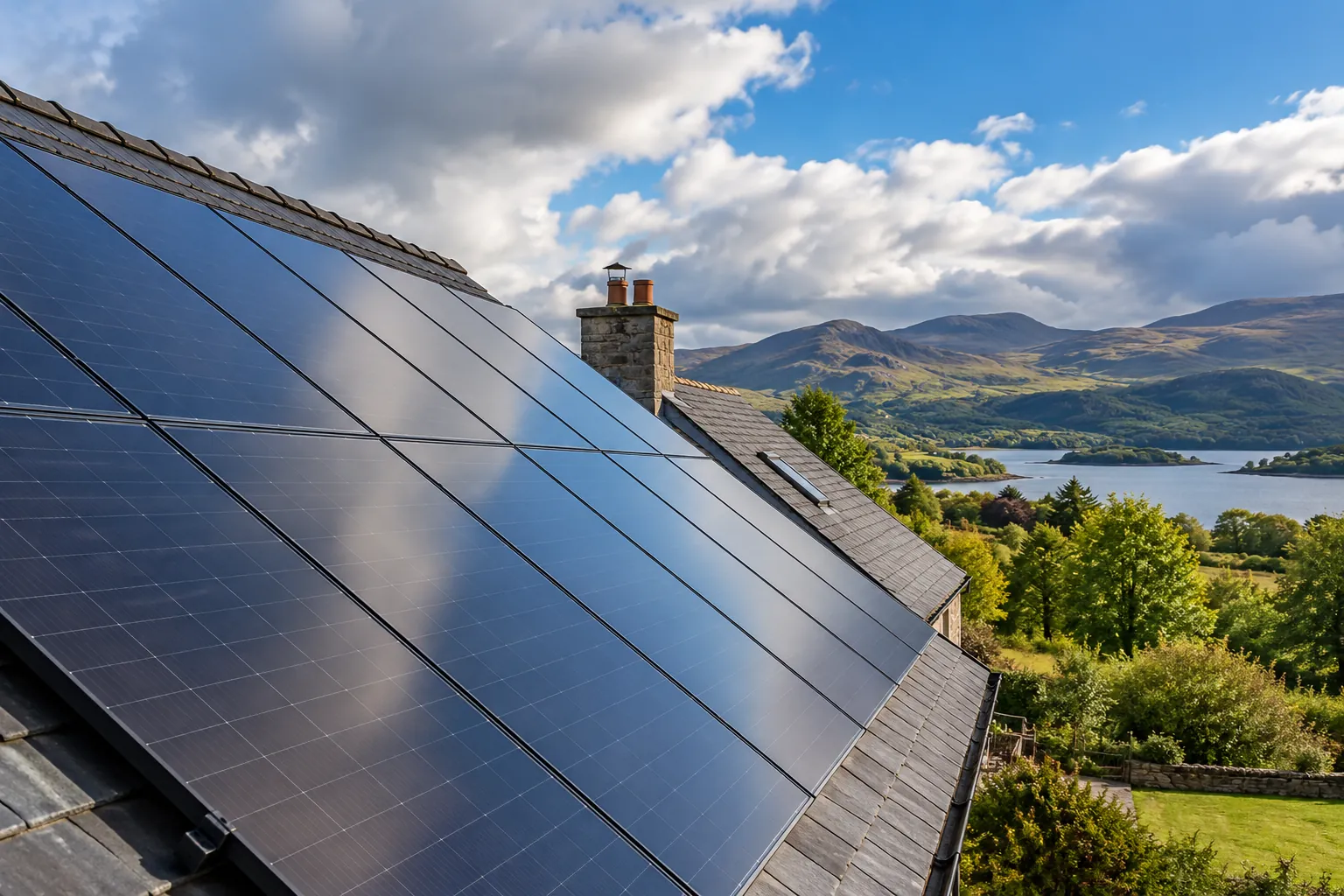
The short answer
Solar can work very well in Scotland — but a good Scottish solar system needs to be designed around the property.
A solar panel does not need Mediterranean heat to produce electricity. It needs light.
Scotland obviously receives less annual solar energy than southern Europe, and winter production can be low because our days are short and the sun remains low in the sky.
But that is only one part of the calculation.
Long summer days, modern high-efficiency panels, sensible roof design, battery storage and increasingly sophisticated electricity tariffs can all contribute to a strong household energy system.
The useful question is: “Does the proposed solar system work for this Scottish home?”
Four useful starting points
Scottish weather
Yes.
Solar cells can use both direct sunlight and diffuse daylight that has been scattered through cloud.
Heavy cloud normally reduces output considerably, but it does not automatically reduce it to zero.
The much bigger seasonal difference in Scotland is daylight duration.
A June day can provide many hours of useful generation. A December day is short, the sun is low and poor weather can suppress output further.
Cold weather itself is not the enemy either. Solar panels can actually operate efficiently at lower temperatures. The limitation in Scottish winter is primarily the amount and angle of available light.
Roof direction
Roof orientation changes both the total amount of electricity generated and the time of day it is produced.
Lower peak output does not automatically mean poorer value. A broader generation curve across the day can sometimes increase the amount of solar electricity used directly in the home.
Scottish roofs
Scotland has an enormous variety of housing.
Modern estates may have straightforward concrete-tile roofs. Older homes may have slate, stone, complex hips, dormers, chimneys, extensions and multiple roof levels.
Flats and tenements introduce ownership and shared-roof issues. Rural homes can be exposed to much stronger wind conditions.
Read how solar panels should be fixed without damaging the roof →
Shading
Trees, chimneys, dormers, neighbouring houses, hills and other obstructions can all reduce generation.
The effect depends on where the shade falls and when it occurs.
A chimney casting a narrow shadow across part of an array is a very different problem from a mature tree shading the entire roof for several winter hours.
This is also where people can be sold unnecessary equipment.
Solar optimisers can be useful in particular designs, but they should not automatically be added to every panel simply because the word “shading” appears in the conversation.
System size
There is no single correct panel count.
The temptation is to count the available roof space and install as many panels as physically fit.
Sometimes that is sensible.
Sometimes it is not.
Each additional panel should add enough useful generation to justify its part of the installation cost.
Battery storage
No.
Battery storage can be extremely useful, but it should solve a household energy problem rather than simply being attached to every quote.
Inverters
Solar panels produce DC electricity.
The inverter converts that into AC electricity the home can use and the grid can accept.
Its rating, number of MPPT inputs, string arrangement, battery capability and network settings all matter.
This becomes particularly important on Scottish homes with several usable roof faces.
A system using south, east and west roof sections may require a very different inverter strategy from an identical panel count installed entirely on one south-facing roof.
Grid connection
Solar generation is connected to the electricity distribution network, so the local network operator needs to know what is being connected.
| Route | Simplified homeowner explanation |
|---|---|
| G98 | Usually the simpler fit-and-inform route for compliant small generation up to 16A per phase — around 3.68kW on a normal single-phase supply. |
| G99 | Used where generation exceeds the G98 limits or the installation otherwise falls outside the simpler G98 route. Network approval may be required before connection. |
Larger solar arrays do not automatically mean that only 3.68kWp of panels can be installed.
The important distinction is the generating equipment and what the system can put onto the network.
Export limitation can sometimes allow a larger system to operate while restricting the amount actually exported, although the DNO still needs to accept the arrangement.
For larger systems it should form part of the design and grid strategy from the beginning.
Electricity networks in Scotland
Most Scottish homes fall within one of two geographic distribution network areas.
Its Scottish distribution area includes locations such as Glasgow, Edinburgh, Fife, Lanarkshire, Ayrshire, Borders and Dumfries.
Its northern Scottish area covers large parts of the Highlands, islands and north-east, as well as several areas north of the central-belt network boundary.
Some newer developments may be connected through an independent distribution network operator rather than the main geographic DNO.
The network operator deals with the physical electricity network. Your electricity supplier sells you electricity and may also buy your exported electricity.
Export tariffs
Solar electricity normally follows a simple order.
Eligible households can be paid for exported electricity through supplier export tariffs, including tariffs operating within the Smart Export Guarantee framework.
Export prices can change substantially between suppliers and tariffs.
Import price, export price and battery strategy all need to be kept separate in a proper financial calculation.
Electric vehicles
An electric car can add thousands of kilowatt-hours of annual electricity demand.
That can justify a larger solar array.
But there is a twist.
The cheapest EV electricity may sometimes come from a very low overnight tariff rather than from charging directly from daytime solar.
If the car is away from the property while the panels are generating, direct solar charging may also be limited.
Heat pumps
A heat pump shifts household heating demand from gas, oil or another fuel onto electricity.
That can dramatically increase annual electricity consumption, making additional solar generation more useful.
The seasonal mismatch is important, however.
Heat-pump demand is normally greatest during Scotland's coldest, darkest months — exactly when solar production is weakest.
That means the answer may involve a combination of:
Planning in Scotland
Many normal domestic rooftop solar installations in Scotland can be carried out using permitted development rights.
That does not mean every property is automatically covered.
In a Scottish conservation area, rooftop panels can fall within permitted development when they are on a rear elevation, or on a side elevation that does not face a road. The normal householder permitted-development route does not cover panels on a listed building or within its curtilage. Listed building consent, planning permission or both may therefore be required for sensitive properties.
Where the most productive roof is restricted, the alternatives may include a less visible roof plane, a suitable outbuilding, a carefully assessed ground-mounted array or a battery-only system charged on an off-peak tariff. Each option still needs its own planning, electrical and financial assessment.
Your local authority can confirm the planning and building-standard position for the individual property.
Cost
I would be very wary of trying to give one universal price per panel.
The equipment is only part of the job.
A cheaper quote can be excellent value.
It can also simply contain less work, weaker equipment, unrealistic assumptions or exclusions you only discover later.
Payback
There is no responsible universal answer.
A quoted payback period depends on assumptions.
I prefer to stress-test the numbers.
What happens if electricity prices increase more slowly? What if export prices fall? What if generation comes in below the headline figure?
If the investment still works under less favourable assumptions, the decision is much stronger.
Investment
But I would not judge solar as an investment in the abstract.
I would judge the specific proposal being made for the property.
The roof needs to work.
The system size needs to work.
The household needs to be able to use or sell the electricity productively.
And the installed price needs to make sense.
It is whether the solar system being proposed is a good investment for your home.
Power cuts
Standard grid-connected solar systems normally shut down when the electricity network fails.
This protects engineers working on the network from electricity being unexpectedly fed back into lines that should be dead.
A battery does not automatically change this either.
Proper backup requires equipment specifically designed to isolate the home safely from the grid and supply selected circuits or the property during an outage.
Scottish solar buyer checklist
Before the final design
Satellite imagery and remote design software are extremely useful.
They do not tell you everything.
I would not want a complex final installation to depend entirely on assumptions made from a screen.
When the answer may be no
There are situations where I would be cautious.
Sometimes the correct answer is not to abandon solar.
It may simply be to install fewer panels, use another roof section, remove a battery, choose another inverter or revise the design.
Frequently asked questions
Yes. Solar panels need daylight rather than hot weather. Scottish winter generation is lower because daylight hours are short, but suitable roofs can still produce substantial useful electricity over the whole year.
Yes. Panels can generate from diffuse daylight, although output falls under heavy cloud compared with bright direct sunshine.
No. South is attractive, but east, west and split east/west arrays can also perform well. The right design depends on the roof and the household's electricity use.
They can be, but I would want the generation from the north-facing section calculated separately and compared with the additional cost. More panels are not automatically better.
Not automatically. A battery can be valuable where electricity is generated at a different time from when it is consumed, or where cheap overnight tariffs can be exploited. It should be sized around the household rather than simply added to every quote.
G98 is the simpler connection route normally used for compliant generation up to 16 amps per phase, approximately 3.68kW on a standard single-phase domestic supply.
Larger or more complex generation typically falls under G99. Network approval may be required before the system is connected, depending on the proposed installation.
Yes, where the installation meets the supplier's eligibility requirements. Export tariff rates and conditions vary, so they should be checked rather than assumed in a savings forecast.
Many ordinary Scottish domestic rooftop installations can use permitted development rights. Restrictions apply around listed buildings, conservation areas, World Heritage Sites and certain other circumstances. Check the individual property where there is doubt.
Yes. An EV can make additional solar useful because it increases household electricity demand, although cheap overnight charging may sometimes be more economical than using daytime solar directly.
Yes, but heat-pump electricity demand is normally highest during winter when solar output is weakest. A good design considers the annual energy picture rather than assuming solar will directly power the heat pump throughout winter.
There is no responsible universal number. Payback depends on system cost, generation, self-consumption, import and export tariffs, battery behaviour and assumptions about future electricity prices.
It can be an excellent long-term investment on the right home at the right price. The useful question is whether the particular system being proposed is a good investment for the particular property.
Tom Solar knowledge centre
Official guidance
This guide is intended to remain evergreen and is reviewed when regulations, network rules or major market arrangements change.
Considering solar in Scotland?
A good solar decision connects the roof, the household, the electrical supply, the grid connection and the economics before thousands of pounds are committed.
Tom Solar provides independent solar feasibility checks, quotation reviews, surveys and system-design guidance for homeowners across Scotland.
I do not install solar panels, so the objective is not to persuade you to buy the largest possible system. It is to work out what actually makes sense for the home.
Tariffs change the calculation
A cheap overnight window, strong export payment or automated battery plan can materially change the result — but only when the household and equipment meet the eligibility rules.