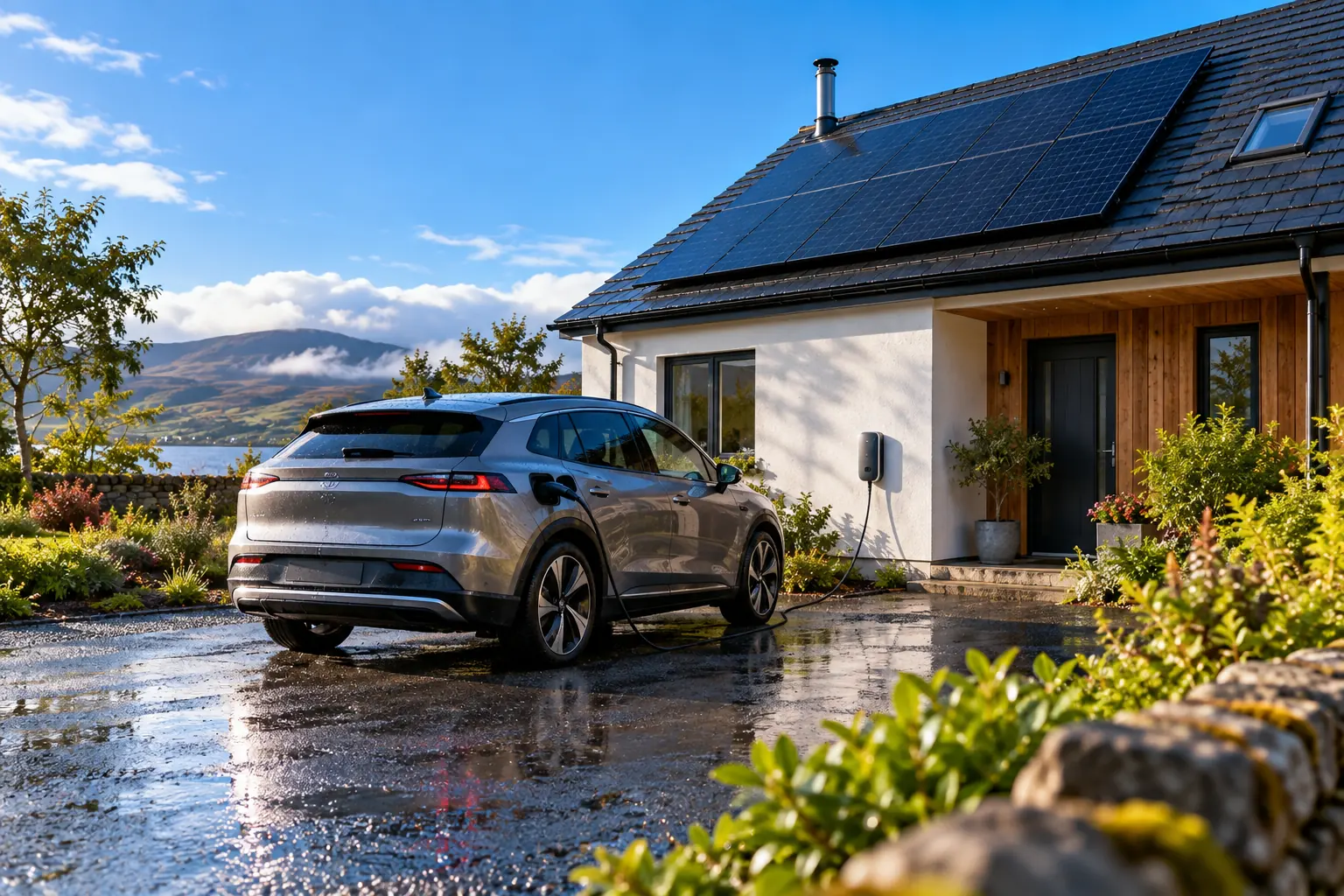
Car at home during the day
Direct solar EV charging can work extremely well because the car provides a huge battery ready to absorb surplus generation.

Electric vehicles and solar explained
An electric car can become one of the largest electrical loads in a home. Drive enough miles and it can add thousands of kilowatt-hours to annual electricity consumption.
That can make additional solar panels extremely useful — but the smartest strategy is not always simply “put every spare solar unit into the car”.
The short answer
Solar becomes financially useful when the electricity it generates has somewhere valuable to go.
An electric vehicle creates a potentially enormous new destination for that electricity.
Depending on mileage, an EV can add several thousand kilowatt-hours to annual household demand.
Treating each component as an unrelated purchase can leave a technically impressive installation behaving very inefficiently.
Start with the mileage
Electric-car efficiency varies substantially with the vehicle, temperature, speed, tyres, heating, driving style and journey type.
For a simple homeowner calculation we can use an illustrative figure of 4 miles per kWh.
That is not a promise that every vehicle will achieve 4 miles/kWh. Some will do better and some considerably worse, especially in cold weather.
So a household that previously used 3,500 kWh per year could move to more than 6,000 kWh of annual electricity demand once regular home EV charging is included.
Solar sizing
Imagine the property needed approximately another 2,500 kWh of electricity each year because of the car.
If a particular roof design was expected to produce roughly 350–400 kWh per year from each modern panel, then approximately six to eight additional panels could generate a similar amount of annual energy.
Annual energy balance and instantaneous power are different. The car may be away when the panels are generating and plugged in when the sun has gone down.
But it demonstrates why designing the solar array around the home's old pre-EV electricity bill can materially understate future demand.
Solar-powered driving
Using our simple illustrative efficiency of 4 miles/kWh:
So 10 kWh of surplus solar delivered into the car could represent roughly 40 miles of theoretical driving energy before allowing for charging losses and real-world variation.
That is one reason EV ownership can substantially increase the value of solar generation that might otherwise have been exported.
The timing problem
This sounds obvious, but it is central to the design.
A homeowner may leave for work at 7:30am and return at 6pm.
The strongest solar generation may have happened while the car was twenty miles away.
Direct solar EV charging can work extremely well because the car provides a huge battery ready to absorb surplus generation.
A home battery, export tariff or different charging strategy becomes more important because the EV cannot receive the midday surplus directly.
A 7kW charger
No.
The 7kW figure is approximately the maximum charging power of a normal domestic single-phase charger.
A suitable solar-aware charger can vary the current supplied to the vehicle according to available surplus generation.
If the solar system has only 3kW spare, the charger does not necessarily need to draw the full 7kW.
It may reduce the vehicle's charging rate instead.
A 7kW charger can spend much of its life charging at less than 7kW.
There is a minimum too
Normal AC EV charging has a minimum charging current.
On a single phase this is typically around 6 amps, or approximately 1.4kW at nominal UK voltage.
If only 700W of surplus solar exists, a charger cannot simply command most vehicles to charge continuously at 700W.
Depending on the charger configuration it may:
A larger PV array can spend more time above the minimum power needed for useful surplus-only vehicle charging.
But here is the clever bit
Suppose, purely as an illustration:
If you divert one solar kWh into the car, you avoid buying a 7p overnight unit — but you also give up 15p of export income.
In that simplified example, exporting the solar and charging the car overnight could be financially better.
Real tariff conditions, charging losses and rate windows still need to be included.
This changes the usual solar advice
| Situation | Potentially sensible strategy |
|---|---|
| Poor export rate | Using surplus solar directly in the EV may be very valuable. |
| High export rate + very cheap overnight EV rate | Exporting solar and charging overnight may produce a better financial result. |
| Car at home during sunny periods | Solar-aware charging can absorb surplus dynamically. |
| Car away every weekday | Home battery storage or export may capture more value from daytime generation. |
| Long journey tomorrow | Ensuring the EV reaches the required state of charge is more important than perfect tariff optimisation. |
Home battery or EV?
There is no universal answer.
An EV battery might hold 50, 70 or even 100 kWh.
A home battery may hold only a fraction of that.
But the home battery has one major advantage:
So the correct priority depends on what the household needs.
Three different strategies
This may make sense when the car is at home, needs significant charge and the homeowner wants to minimise purchased driving energy.
This may make sense where evening household electricity is expensive and the EV can be charged very cheaply overnight.
This can be rational where the export rate exceeds the cost of buying replacement electricity during a cheap charging period.
Increasingly sophisticated chargers, batteries and energy management systems can schedule energy according to generation, prices and required EV charge levels.
Smart charging
Private EV chargers sold for domestic use in Great Britain are subject to smart-chargepoint regulations.
Among other requirements, compliant chargers include smart functionality allowing charging to respond to timing or external signals.
This helps charging move into periods when:
The charger should also allow the owner to override smart scheduling when immediate charging is required.
A very important buying decision
This distinction catches people out.
A charger can comply perfectly well with UK smart-chargepoint regulations and still not integrate with a particular supplier's managed EV tariff.
Some tariffs control:
Do not spend hundreds of pounds installing a charger and only then discover that the electricity tariff you wanted cannot control it. Supplier compatibility lists can change, so check the current list before installation.
Connectivity matters too
Smart tariffs, app control, charge scheduling and remote energy management depend on communication.
Depending on the charger this may use:
UK smart-chargepoint rules include provisions intended to allow ordinary charging to continue if communications are lost.
But losing communication can still interfere with the smart features that made the charger attractive in the first place.
Good connectivity at the kitchen table does not prove good connectivity at a detached garage or outside wall.
A high-demand example
And that is for one illustrative EV.
A household with two electric cars, high annual mileage, a heat pump and electric hot water can become an entirely different energy proposition.
Planned electrification belongs in the solar calculation from the start.
Two EVs
Two 7kW chargers do not necessarily need to draw 14kW simultaneously.
Load management can distribute available power between chargers and other household equipment.
But a property containing:
deserves a proper whole-property electrical assessment.
Do I need three phase?
Most familiar domestic chargers are single phase and around 7kW.
Three-phase installations can support higher AC charging power such as approximately 11kW or 22kW where:
The car's onboard AC charger ultimately limits how quickly it can accept AC electricity.
See our separate guide: Should I upgrade my home to three-phase electricity?
The DNO
A home charger is a significant electrical load.
The local Distribution Network Operator needs visibility of new EV charging installations and the installer normally deals with the relevant notification process.
Additional investigation may be needed where there are concerns about:
If you are unsure what a looped supply means, see: What is a looped electricity supply?
What about V2H and V2G?
Bidirectional charging allows electricity to flow both into and out of an electric vehicle.
This creates possibilities including:
An EV battery can be many times larger than a normal home battery, so the potential is enormous.
Bidirectional capability is not yet universal. The vehicle, charger, controls, tariff and grid-connection arrangement all need to support it.
The future
Government energy policy is increasingly looking at EV smart charging and bidirectional vehicle-to-everything technology as sources of flexibility for the electricity network.
In future, millions of parked EVs could potentially:
That makes charger interoperability and good system design increasingly important.
Before choosing the solar system
Evidence behind the proposal
If an installer says the EV means you need a larger solar system, ask them to show why.
The calculation should be understandable.
Equally, ignoring thousands of kilowatt-hours of foreseeable EV demand can leave a customer with a system that was undersized from the day it was installed.
One whole energy system
Generates the low-cost electricity available to the property.
Moves electricity from one part of the day to another and can exploit cheap tariffs.
Creates a large, flexible electricity demand that can often be moved to favourable times.
Controls when and how quickly the vehicle receives electricity.
Determines whether consuming, storing, importing or exporting each kWh creates the greatest value.
Decides how the available generation and storage should be prioritised.
Frequently asked questions
Often yes. An EV can materially increase annual household electricity demand, creating much more opportunity for a suitably sized solar system to reduce imported electricity.
It depends on mileage and vehicle efficiency. At an illustrative 4 miles/kWh, 10,000 miles requires roughly 2,500kWh of driving energy before charging losses are considered.
Potentially. Expected EV electricity demand should be added to existing household consumption before deciding how much PV is appropriate.
Yes. A compatible solar-aware charger can vary vehicle charging according to available surplus generation.
No. Seven kilowatts is approximately the maximum charging power. Smart charging can operate below that level where the charger and vehicle support it.
Normal single-phase AC charging generally requires around 6 amps, approximately 1.4kW. Below that, a solar-aware charger may pause or supplement the solar with grid electricity.
No. If your export rate is higher than your overnight import rate, exporting solar and buying cheap electricity later may be financially better.
Not necessarily. It becomes more useful where the car is away during sunny periods, evening household demand is high or cheap grid electricity can be stored for later use.
It depends on driving requirements, evening demand, import prices and export rates. There is no single priority that is correct for every household.
No. Supplier eligibility varies by vehicle and charger, so current compatibility should be confirmed before installation.
Some compatible bidirectional systems can support vehicle-to-home operation, but the technology is not yet universally supported by vehicles, chargers or tariffs.
Domestic installations are normally notified to the local DNO, typically by the installer. Some properties require additional network assessment.
Official guidance checked
This guide was reviewed against current material available in August 2026 including:
Vehicle efficiency, charger compatibility and electricity tariffs change over time. The current vehicle specification, charger documentation, supplier eligibility rules and DNO requirements take precedence over the illustrative examples in this homeowner guide.
Related Tom Solar guides
Tom Solar view
An EV can materially change the annual electricity consumption of a home.
Designing solar around the household's historic electricity bill while ignoring thousands of miles of future electric driving can leave the system unnecessarily small.
But simply covering the roof and telling the customer to charge the car whenever the sun shines is not sophisticated enough either.
The real design should consider:
Design the house, solar, battery, tariff and car as one connected energy system.
I'll check your roof free so you can see what the property may actually be able to accommodate before thinking about system size.
Check My Roof FreeScottish homeowners only · No obligation · No sales call required