Voltage
Too much local generation can push voltage upwards. The network must stay inside statutory operating limits.

Grid connections explained
G98 and G99 sound like obscure pieces of electrical paperwork. In reality, they can decide how powerful your solar system is allowed to be, how much electricity you can export and whether you may have to wait weeks for permission before the full system can operate.
Here is the process in ordinary language — including the 3.68kW rule, G100 export limits, long G99 waits, local grid capacity and what homeowners should be told before signing.
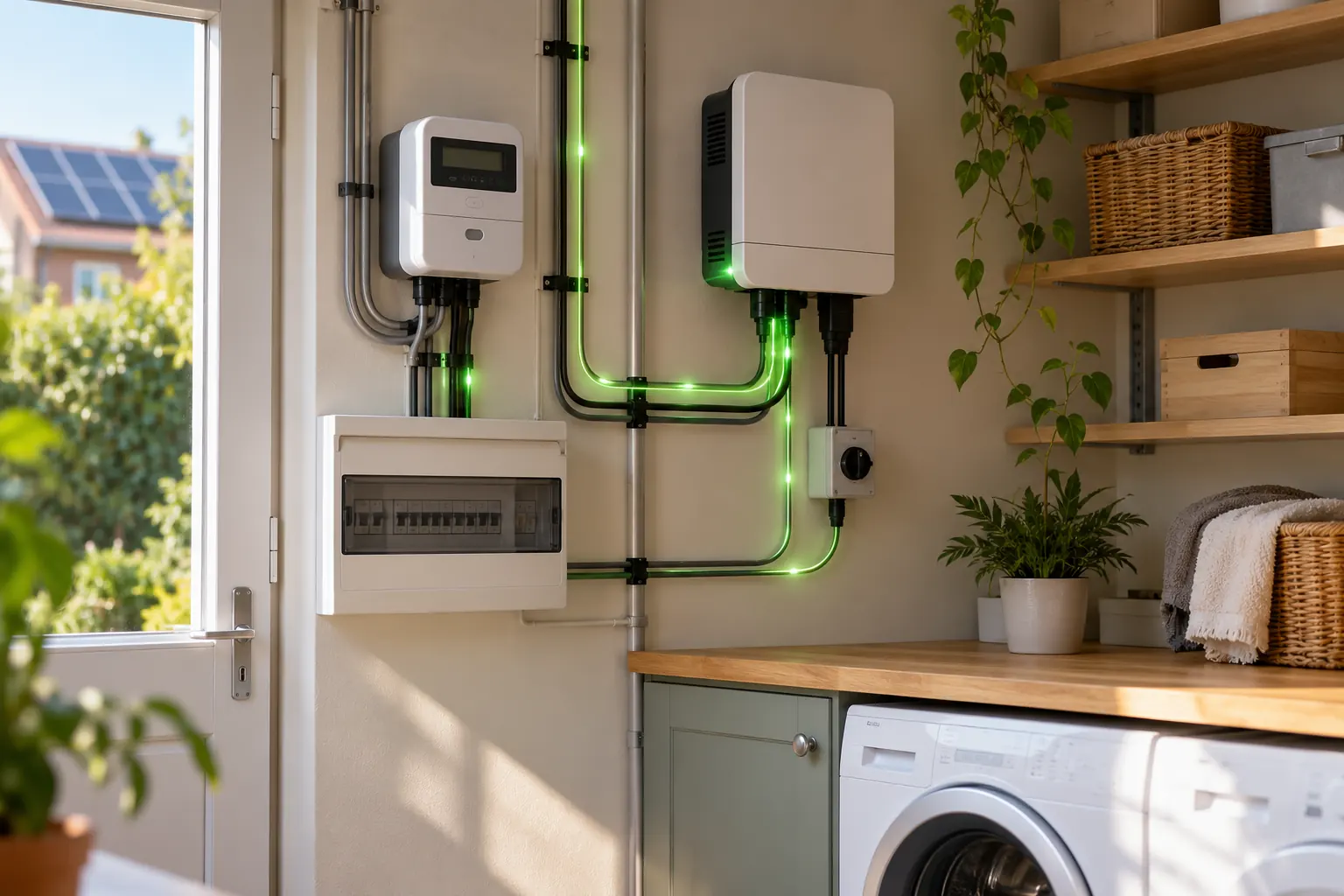
The short answer
For a typical single domestic property, generation that qualifies for G98 and is no greater than 16 amps per phase — approximately 3.68kW per phase on a 230V supply — can normally be installed and the Distribution Network Operator notified afterwards.
The installer must then provide the required G98 notification, normally within 28 days of commissioning.
Once generation goes above that level, or the installation does not otherwise meet the G98 requirements, the connection generally moves into G99 territory.
G99 exists because the network operator needs to understand what a larger generator may do to the local electricity network before it is allowed to operate as proposed.
G98: qualifying small generation — connect and notify.
G99: larger or more complex generation — normally
apply and obtain the appropriate network agreement first.
The number everybody remembers
This is probably the most common source of confusion.
A homeowner hears “3.68kW” and understandably assumes:
No.
The G98 threshold concerns the electrical generating capacity connected to the AC network — not simply the total wattage printed on the solar panels.
For example, a house can have more than 3.68kWp of solar panels connected to a 3.68kW inverter.
During exceptionally strong solar conditions, the panels may be capable of producing more DC power than the inverter is permitted to turn into AC power. The inverter then limits, or “clips”, the output at its maximum AC capability.
Solar panels are normally described by their total DC peak capacity in kWp. The inverter has an AC power rating in kW. G98 and G99 connection decisions cannot be understood by looking at the panel wattage alone.
Side by side
| Question | G98 | G99 |
|---|---|---|
| Typical domestic use | Qualifying smaller microgeneration | Larger or otherwise non-G98 generation and storage arrangements |
| Common single-phase threshold | Up to 16A per phase, approximately 3.68kW | Normally above 16A per phase, subject to the exact connection route |
| Network permission | At one qualifying premises, normally fit first and notify afterwards | Normally apply before connecting and operating the proposed larger generation |
| Network assessment | Limited for a normal single-premises notification | The DNO may assess local network conditions and available capacity |
| Possible export restriction | Generation is already within the G98 limit | The DNO may agree full export, impose a lower export limit or require another solution |
| Waiting period | Normally no pre-install approval wait for a qualifying single premises | Can range from relatively quick decisions to many weeks depending on route and network conditions |
This is a homeowner summary, not a substitute for the current ENA Engineering Recommendations or the relevant DNO's connection procedure. Modern combinations of generation and storage can also qualify for specific G99 fast-track processes.
Who makes the decision?
This distinction is important.
Octopus, British Gas, E.ON, EDF and other electricity suppliers sell electricity and may pay you for exported electricity.
They do not own the local electricity cables feeding your street.
The Distribution Network Operator — DNO operates that local network.
In Scotland, the DNO is commonly either SP Energy Networks or Scottish and Southern Electricity Networks, depending on where the property is located.
It is the DNO that considers whether the proposed generation can connect to its network at the requested capacity.
What are they actually checking?
Behind the paperwork is a genuine engineering question:
Too much local generation can push voltage upwards. The network must stay inside statutory operating limits.
Local cables have finite thermal and electrical capacity. Power flowing back through them still has to remain within safe limits.
The local transformer may already serve many properties with a mixture of electricity demand and generation.
Generation equipment must disconnect and behave correctly when network faults or abnormal conditions occur.
Your proposed solar system is not assessed in complete isolation. Other connected generation can affect available network headroom.
Batteries can discharge as well as solar panels generate. The DNO needs to understand the maximum possible behaviour of the installation at the connection point.
Another misunderstood number
Battery specifications introduce another pair of numbers that are regularly confused.
kWh measures energy storage capacity.
kW measures power — how quickly energy can be charged, discharged or exported.
Two 9.4kWh batteries therefore provide around 18.8kWh of nominal stored energy, but that does not automatically mean they can export 18.8kW.
The DNO needs to know the inverter and battery system's actual power capability and how it is controlled.
A normal 7kW EV charger is a load: it consumes electricity. It does not by itself cause a solar system to require G99. Two 7kW EV chargers can be very important to the property's overall electrical demand, but they are different from generation.
Enter G100
This is where G100 becomes important.
G100 deals with customer export and import limitation schemes.
In simple language, a G100-compliant system can act like an electronic gatekeeper at the property's connection to the network.
Imagine the property has equipment capable of producing 10kW but the DNO only agrees to 5kW of export.
A properly designed export limitation arrangement can ensure the property never sends more than the agreed amount onto the network.
Electricity can potentially still be used inside the home, stored in batteries or directed to flexible loads, while the export at the boundary remains limited.
A house can sometimes have substantial generation and storage equipment while its maximum permitted export is set lower by the DNO and enforced by an approved limitation scheme.
“Clip and wait”
Solar companies do not all use the same policy.
Some installers prefer to obtain the required G99 agreement before beginning the installation.
Others may physically install the equipment while the application is being assessed and leave the generation uncommissioned, constrained or otherwise operating only within an arrangement that is permitted while the final connection position is resolved.
The homeowner should be told exactly what has been limited. Is the inverter's total AC output constrained? Is only export constrained? Is the system operating at zero export? Can the batteries charge and discharge normally? The technical and regulatory arrangement must comply with the applicable connection rules and any DNO permission.
A homeowner should never simply assume that installing a larger G99 system gives an automatic right to operate it at 3.68kW while waiting. The permissible temporary arrangement depends on the connection route, equipment and network operator requirements.
The painful part
This is where expectation management matters enormously.
Homeowners are often told figures such as:
None of those should be presented as a universal promise.
As of August 2026, Ofgem publishes a 45-working-day performance level for provision of a low-voltage generation quotation.
Forty-five working days is approximately nine working weeks.
But there is an important qualification:
The standard relates to provision of an LV generation quotation, and the clock depends on receipt of the necessary information. Requests for further information, different connection routes, technical complications and other circumstances can affect the real-world journey.
What about thirteen weeks?
A 65-working-day period is approximately thirteen working weeks.
That figure appears in the standards for certain higher-voltage generation quotations.
For the ordinary domestic low-voltage situation, the more relevant published performance level is generally the 45-working-day LV generation quotation standard.
So if a straightforward domestic LV application has been sitting for eleven weeks, the right question is not simply:
It is:
A real Scottish example
One recent Scottish installation illustrates the problem particularly well. At the time the system was sold, the expected G99 wait was explained as approximately six to eight weeks.
The property also has two 7kW EV chargers and unusually high opportunities to use energy on site.
Yet more than eleven weeks after the application process began, the homeowner was still waiting for the desired G99 connection position to be resolved.
The delay became particularly frustrating because it coincided with excellent summer solar conditions.
Depending on the temporary operating restrictions, the household may still be able to use solar electricity itself and charge batteries, but any generation that cannot be usefully consumed, stored or exported represents an opportunity that cannot simply be recovered later.
Where a completed system is prevented from making the export it would otherwise have made, sunny weeks can translate into export income that the homeowner never receives. The amount depends on actual generation, self-consumption, battery behaviour, the export limit and the export tariff.
Example anonymised. Situation described as at August 2026. The figures are included to explain the connection issue rather than to make a claim about the final DNO outcome.
Two different installer policies
The installer submits the application and does not proceed with the larger generation installation until the network position is known.
Advantage: the homeowner knows the connection conditions before the final system is installed.
Disadvantage: the property receives no solar benefit during the waiting period because there is no completed system yet.
The equipment is physically installed before the full G99 outcome, but it must only be commissioned or operated in a manner permitted by the applicable connection rules and DNO arrangements.
Advantage: depending on the permitted temporary arrangement, some solar or storage benefit may begin sooner.
Disadvantage: a long delay can leave an expensive completed system unable to operate exactly as the homeowner expected.
Before signing, the homeowner should be told which approach will be used, what happens if approval takes longer than expected and what restrictions may apply during the wait.
The bigger problem
People often describe this as a problem with “the National Grid”, but the cable under a residential street is normally part of the local distribution network.
In many established and post-war communities, parts of that local infrastructure have been serving homes for decades.
Age alone does not mean a cable is unsafe or needs replacement. Network companies inspect, maintain, reinforce and replace assets according to their condition and the demands placed upon them.
The bigger issue is how dramatically the job of that infrastructure is changing.
A network built when domestic electricity demand was far simpler is now being asked to support transport, heating, storage and local electricity generation simultaneously.
A mammoth modernisation programme
It would be wrong to say that nothing is being done.
Britain's Distribution Network Operators are already investing in reinforcement, replacement, monitoring, flexibility and digital network management.
But Ofgem describes the coming electrification of the economy as creating unprecedented demand on the local electricity network.
Britain's distribution system extends across roughly 800,000 km of network and serves around 30 million customers.
Upgrading that infrastructure is not one project. It is thousands upon thousands of local interventions: cables, substations, transformers, protection systems and digital controls.
That work will continue for many years as EVs, heat pumps, batteries and distributed generation become commonplace.
The capacity question
Yes — local export headroom is finite.
But it should not be described as if a street contains a fixed number of solar “spaces” and the tenth customer automatically takes the last one.
Network capacity is more complicated than that.
Constraints can involve local voltage, feeder loading, transformer capacity or conditions farther upstream.
As additional generation connects, the amount of spare export capacity available for another property can change.
A later applicant might therefore be offered:
Your neighbour receiving 10kW of export capability today does not guarantee that an identical 10kW connection will be available to your property at some later date.
Genuine urgency — without scare tactics
There can be an advantage in obtaining the connection capacity a genuine proposed system needs while that capacity is available.
What we should not say is:
That creates a certainty that does not exist.
A more accurate statement is:
As more generation and storage connect locally, a future applicant may not necessarily receive exactly the same connection terms that are available today.
Equally, homeowners should not request artificially oversized connections purely to speculate on future capacity.
A connection offer is not simply a permanent slot that can be applied for and stored indefinitely without completing the project.
A fascinating future question
Potentially — but this needs careful wording.
There is a logical practical advantage to a property that already has an established higher-capacity generation and export arrangement, especially if local capacity later becomes more constrained.
A future buyer who wants substantial solar, batteries, EV charging and electric heating may appreciate that the property already has greater electrical capability.
However, there is not yet enough robust UK property-market evidence to isolate the value of a higher G99/export capacity and say:
We cannot responsibly make that claim.
It is better understood as a potentially useful property capability rather than a guaranteed cash uplift.
The process cannot stay manual forever
Domestic G99 applications are becoming increasingly routine as larger solar arrays, hybrid inverters and batteries become normal.
At the same time, EV charging and electric heating are increasing the complexity of the local network.
Putting every straightforward domestic case through a slow, heavily manual engineering queue will become increasingly difficult to justify as application volumes grow.
Much of the information in an application is structured:
Standard approved equipment, adequate network headroom and no unusual conditions. The connection is processed automatically or with minimal human intervention.
Connection appears possible but only with a defined export limit, G100 control or another standard condition. A rapid assisted review confirms the arrangement.
Genuine network constraint, unusual equipment, voltage concern or reinforcement requirement. The case goes to a network engineer for proper human assessment.
The sensible goal is not “AI replaces the network engineer”. It is “automation clears routine applications quickly so qualified engineers can spend their time on the difficult connections that genuinely need engineering judgement”.
This direction is already visible in UK energy policy.
Ofgem's framework for the 2028–2033 electricity distribution period includes a stronger focus on faster approval of straightforward low-carbon connections, while wider innovation programmes are exploring much more automated and plug-and-play domestic energy connections.
Before you sign
Expectation management
That is less exciting than promising “six weeks”.
It is also far less likely to leave a homeowner furious eleven weeks later.
Frequently asked questions
For a typical single domestic property, qualifying generation at no more than 16 amps or about 3.68kW per phase can usually follow the G98 fit-and-notify route. Larger generation, or equipment that does not qualify for G98, normally requires a G99 connection process and the network operator must generally assess it before it is connected.
No. The 3.68kW figure relates to the AC generating capacity and connection rules, not simply the total wattage printed on the solar panels. A solar array can have more than 3.68kWp of panels while using a 3.68kW inverter.
The Distribution Network Operator owns and operates the local electricity network serving the property. It is different from the electricity supplier. In Scotland, the relevant DNO is commonly SP Energy Networks or Scottish and Southern Electricity Networks, depending on location.
G100 is the engineering recommendation covering customer export and import limitation schemes. In simple terms, a compliant control system can prevent a property from exporting more electricity to the local network than the DNO has agreed.
There is no single guaranteed approval time for every case. For low-voltage generation quotations, Ofgem publishes a 45-working-day performance level once the necessary information has been received. That is roughly nine working weeks, but it is not a universal guarantee that every G99 application receives final approval within nine weeks.
Not as a blanket domestic rule. A 65-working-day standard, roughly thirteen working weeks, applies to certain higher-voltage generation quotations. A typical domestic low-voltage generation quotation is associated with the 45-working-day performance level.
Local networks have finite capacity, so available export headroom can change as more generation and storage connect. That does not necessarily mean further solar becomes impossible. The DNO may offer a lower export limit, require an export limitation scheme, propose network reinforcement or offer another connection arrangement.
Potentially as a practical capability, especially if local network capacity becomes constrained, but there is not yet enough robust UK property-market evidence to put a reliable cash value on G99 export capacity itself. It should not be marketed as a guaranteed increase in property value.
An ordinary EV charger is an electrical load rather than generation, so its 7kW charging rating does not by itself make a solar system G99. EV charging can still be relevant to the property's overall electrical design.
Battery storage can matter because a battery inverter can behave as a generator when discharging electricity. The DNO is interested in power ratings and possible network flows, not simply the battery's energy capacity in kilowatt-hours.
Equipment may sometimes be physically installed before the G99 decision, but the generation must not simply be connected or operated beyond what the applicable connection rules and DNO permission allow. Some installers wait for approval, while others install equipment and leave it uncommissioned or appropriately restricted.
Increasing automation is plausible and parts of the connection process are already being digitised. Straightforward applications contain structured information that can potentially be checked automatically against equipment records and network capacity, while unusual or constrained cases can remain subject to human engineering review.
Official guidance checked
This guide was reviewed against current guidance available in August 2026, including material from:
Connection requirements evolve. The actual DNO connection offer and current engineering recommendations take precedence over this homeowner guide.
Related Tom Solar guides
Before buying
G98 and G99 are good examples of why solar should be designed around the property rather than sold as a bundle of equipment.
Roof capacity, electricity demand, battery requirements, inverter size, EV charging, heat pumps, cable routes and the local grid connection all interact.
If two solar companies are recommending completely different system sizes, the answer is not simply to choose whichever salesperson sounds most confident.