Exact direction
North-east, north, and north-west are not the same orientation. The actual azimuth should be considered rather than applying one blanket rule to an entire half of the compass.

Solar roof questions answered
One installer says never put solar panels on a north-facing roof. Another wants to use every available roof section.
Neither rule is good enough on its own. A north-facing roof should be judged by what it can actually produce, what the extra panels cost and whether the household can use the energy.
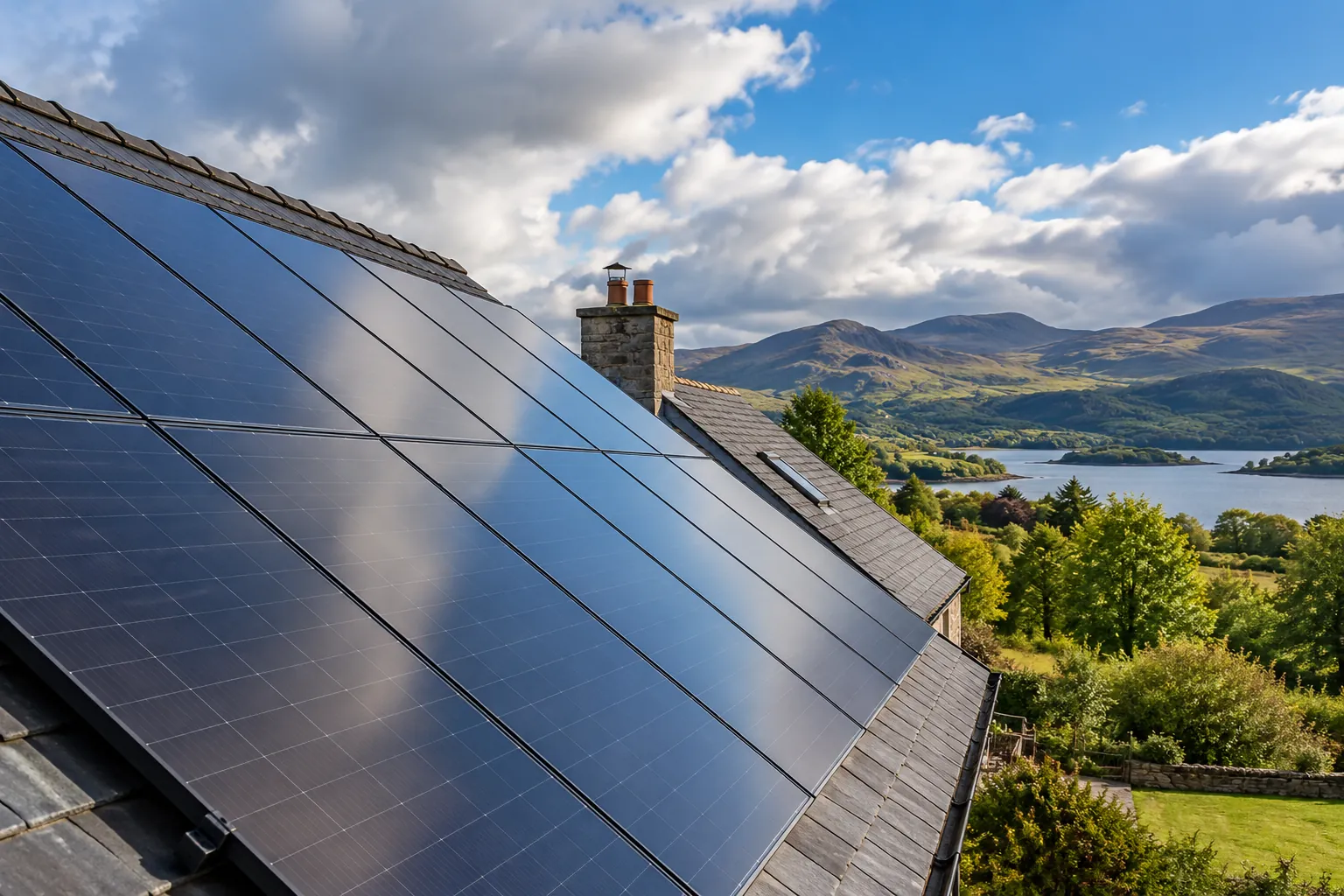
The short answer
Yes — north-facing solar panels can be worth installing, but not on every roof and not at any price.
Roof direction matters because it changes how much solar energy reaches the panels across the year.
A south-facing roof generally has a natural advantage in the UK, but that does not make every other orientation unsuitable.
The useful question is:
Then compare that generation with the additional cost and the household's ability to use it.
What determines the answer?
North-east, north, and north-west are not the same orientation. The actual azimuth should be considered rather than applying one blanket rule to an entire half of the compass.
A shallow roof and a steep roof expose the panels to daylight differently. Pitch can therefore make a major difference to the usefulness of a northerly orientation.
Trees, neighbouring buildings, chimneys and roof features can matter just as much as compass direction.
Additional panels may be relatively inexpensive when they are being fitted as part of a larger installation, but expensive structural or electrical complications can change the calculation.
Extra generation has more value when the household can use, store or beneficially export it.
String design, MPPT allocation, inverter sizing and other roof orientations can influence whether adding another roof section makes technical sense.
Not all north is equal
Homeowners are often told that any roof containing the word “north” should be ignored.
That is too crude.
A roof that is only slightly north of east or west should not be treated in the same way as a steep roof pointing directly north.
Roof pitch matters
Imagine two roofs that both point north.
One is shallow. The other is steep.
Although the compass direction is identical, the angle at which those panels see the sky is very different.
That can produce significantly different annual generation.
“North-facing” by itself is not enough information to judge a roof.
Scottish conditions
Solar panels generate electricity from daylight, not only from bright direct sunshine.
Scotland has long summer daylight hours and also many periods of diffuse light under cloud.
That does not remove the disadvantage of a poor orientation, but it is one reason why the real answer should come from a generation estimate rather than a simple compass rule.
A north-facing Scottish roof may still generate useful electricity across the year.
The question is whether the predicted amount is enough to justify using that roof space.
When north-facing panels can make sense
None of these points proves that north-facing panels should be fitted.
They explain why automatically rejecting them can also be a mistake.
When they may not make sense
A particularly steep due-north roof with significant shading may offer relatively poor annual generation.
If using that roof also requires extra scaffolding, complex cabling, additional optimisers or other costly work, the economics can weaken further.
The household may also have little need for the extra generation.
The extra roof area should earn its place in the design.
East-west-north combinations
A solar system does not have to consist of one single roof face.
Some properties may use combinations of east, west, south, north-east or north-west roof areas.
These sections produce electricity at different times and at different levels.
That can sometimes create a wider generation profile rather than concentrating most production around one period of the day.
But the inverter must also be able to deal sensibly with the different strings and orientations.
This is where MPPT availability and inverter design become important.
Batteries
If additional north-facing panels create surplus electricity at times when the house does not need it, a battery may store some of that generation for later.
That can improve self-consumption.
But a battery does not change the physical generation potential of the roof.
Do not use a battery to disguise weak solar design.
For more detail, see What Size Solar Battery Do I Actually Need?
Panel count
A quotation may look impressive because it contains more panels than a competing proposal.
But panel count by itself says very little.
Fifteen well-positioned panels may be more useful than twenty panels spread across poor roof sections.
Equally, twenty panels may be the better design where the additional roof sections still produce useful electricity and the household has sufficient demand.
The number should follow the design.
Inverter design
Panels on different orientations may need to be separated into appropriate strings and MPPT inputs.
That means the inverter choice can affect whether a complicated roof layout works properly.
An installer should be able to explain:
Three roof examples
Little shading, useful roof area and a modest pitch. This may deserve serious consideration rather than automatic rejection.
A much more challenging orientation where predicted generation needs to justify the extra installation cost.
Additional later-day generation may still be valuable where the house has substantial electricity demand and better roof areas are already fully used.
Questions to ask the installer
If the installer cannot show why the additional roof area makes sense, the panel count alone is not a justification.
Common questions
They can be. They normally produce less electricity than well-positioned south-facing panels, but roof pitch, exact orientation, shading, cost and household demand can still make them worthwhile.
No. The roof should be assessed rather than rejected automatically. North-east and north-west roofs in particular can sometimes provide useful generation.
Yes. Two roofs pointing in exactly the same direction can perform differently if their pitches are different.
Generally they have more favourable solar exposure than a roof pointing directly north, although pitch and shading still matter.
Yes. Panels generate from daylight as well as direct sunshine. The sensible approach is to calculate expected annual generation for the actual Scottish property.
Potentially. If additional generation still has useful value and the north-facing roof performs reasonably, using extra roof space can make sense.
A battery can help use the electricity at a different time, but it cannot increase the amount of electricity produced by the panels.
Consider exact direction, pitch, shading, usable roof area, predicted generation, additional installation cost, household demand, tariffs and the complete system design.
Related Tom Solar guides
Measure the roof before judging it
Tom Solar looks at the actual direction, roof pitch, shading, usable space, generation potential, household demand and wider system design before deciding which roof sections are worth using.
I'll check the usable roof space, orientation and obvious obstacles free, then tell you whether it looks worth investigating further.
Check My Roof FreeScottish homeowners only · No obligation · No sales call required