Annual generation
The proposal should show a realistic estimate for the actual location and roof.

Scottish solar weather explained
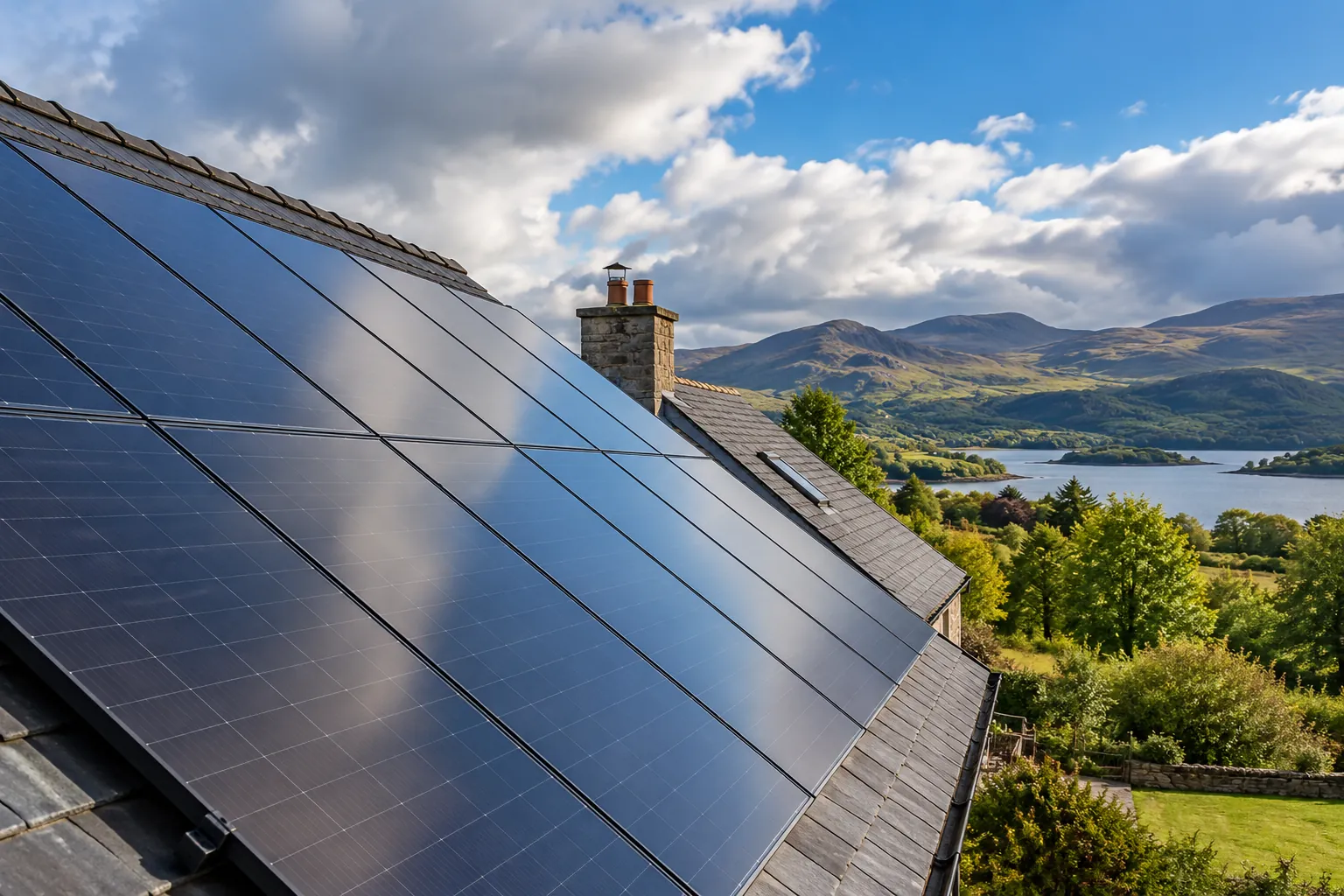
Yes. Solar panels need light — not a hot sunny day.
A grey Scottish sky can still produce electricity, and a freezing bright January afternoon can produce surprisingly strong instantaneous power. The real winter problem is not cold. It is simply that much less solar energy reaches the roof over the day.
The short answer
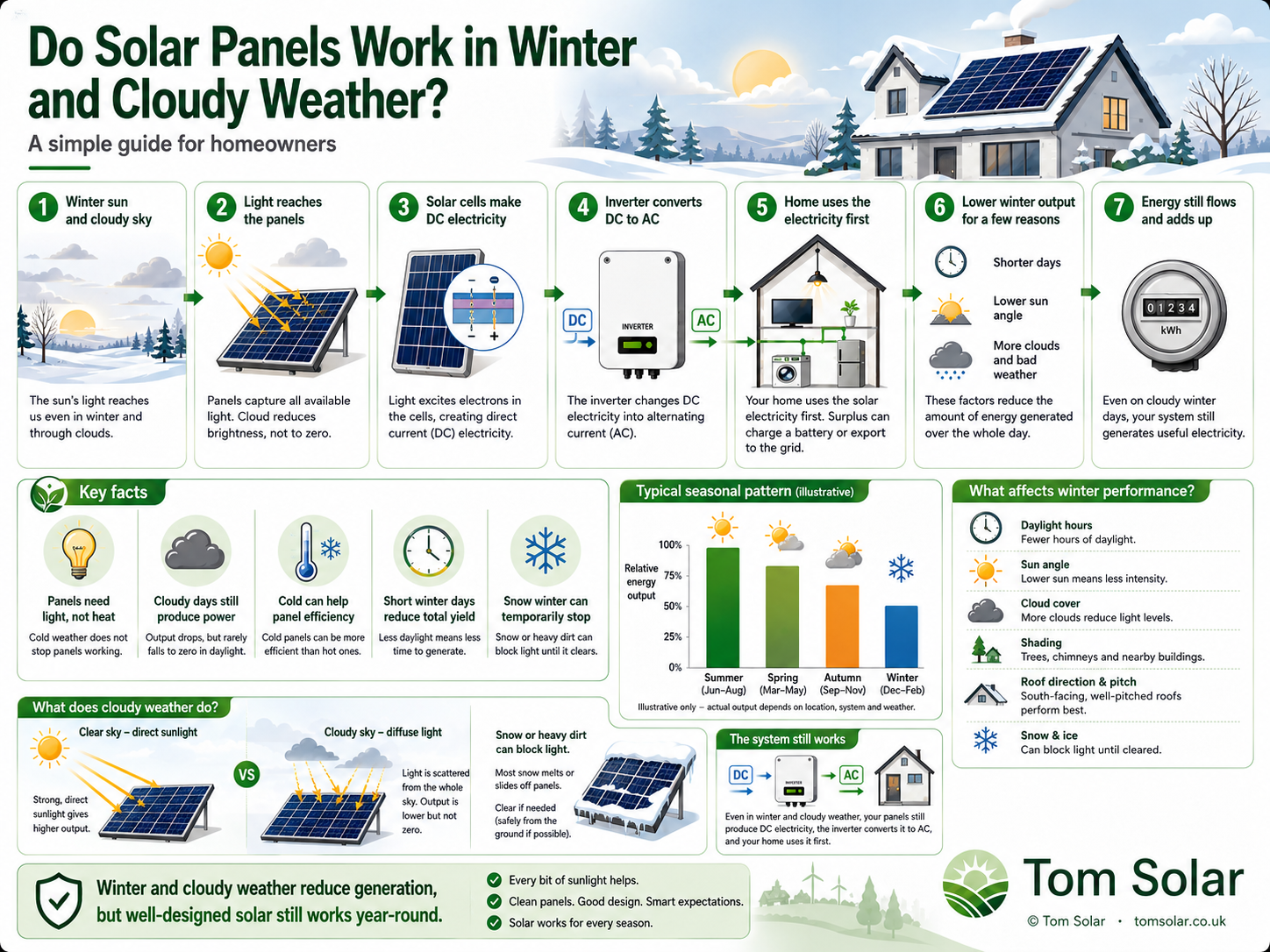
A solar cell starts producing electricity when sufficient light reaches the semiconductor.
That light does not have to arrive from a perfectly clear blue sky.
On a cloudy day, sunlight is scattered by the atmosphere and clouds. Some still reaches the roof as diffuse solar radiation.
The panels convert part of that available light into electricity.
The amount of electricity simply follows the amount and quality of solar energy reaching the array.
Tom Solar visual guide
Why winter generation falls
Scotland's winter solar production falls for several reasons at once.
If you could give the same silicon panel exactly the same sunlight while keeping it cooler, its electrical performance would normally improve rather than deteriorate.
Cold versus hot
This is one of the most useful solar facts to explain to homeowners.
Solar panels are not solar water heaters.
They do not need heat.
As a conventional silicon photovoltaic cell becomes hotter, its electrical current rises slightly — but its voltage falls by more.
The result is normally a reduction in maximum electrical power.
A January surprise
Yes.
Imagine a clear, crisp winter afternoon with very strong direct sunlight and panels that remain cold because the air temperature is low.
Under those conditions the array can produce impressive instantaneous power.
But that does not mean January suddenly becomes equivalent to June.
The winter day started later, the sun remains lower and darkness arrives far sooner.
The system might briefly produce a high number of kilowatts, while still producing far fewer total kilowatt-hours across the whole winter day.
Four conditions compared
| Weather | What the panel experiences | Likely effect |
|---|---|---|
| Bright + cool | Strong irradiance and relatively low cell temperature. | Excellent instantaneous PV conditions. |
| Bright + very hot | Strong irradiance but elevated cell temperature. | Strong generation, but heat reduces power relative to an equally bright cooler panel. |
| Bright overcast | Substantial diffuse light with reduced direct radiation. | Useful generation, normally below clear-sky output. |
| Dark heavy cloud | Much less solar radiation reaches the module. | Generation can fall dramatically but is not necessarily zero. |
Diffuse daylight
On a clear day, a large part of the useful solar radiation may arrive directly from the direction of the sun.
On an overcast day, light is repeatedly scattered by water droplets, ice crystals, air molecules and particles in the atmosphere.
The result is the familiar evenly illuminated grey sky.
That light still contains energy.
Some of it reaches the solar cells and produces electricity.
Even when direct sunlight is blocked, a panel can receive useful diffuse radiation from a large area of sky.
Why Scottish winter is different
Scotland sits far enough north that the difference between summer and winter daylight is enormous.
In summer the sun:
In winter the opposite happens.
This strongly concentrates annual PV generation into the brighter parts of the year.
Winter shadows
Shadow length changes with solar elevation.
When the sun is high in summer, a chimney or neighbouring building may cast a relatively short shadow.
When the sun is low in winter, that same obstacle can cast a shadow many times farther across the roof.
Good system design considers the solar path and expected annual shading rather than judging the roof only from the shadow visible during a single site visit.
Trees behave differently too
Shading is rarely a simple all-year percentage.
A large deciduous tree may create substantial summer shading when it is covered in leaves.
In winter it may lose most of that foliage.
At the same time, however, the low winter sun creates much longer branch and trunk shadows.
Evergreen trees behave differently again.
The important number is the effect across the expected year, not whether a shadow happens to be visible when somebody stands on the driveway.
Snow
Snow is different from cloud.
Cloud reduces the amount of light reaching the roof.
A layer of snow lying directly over the module can physically block light from reaching the photovoltaic cells.
A heavily covered panel can therefore generate very little until sections become exposed.
Tilted rooftop panels often clear naturally as:
Do not attack the roof with a brush
It can be tempting to see snow on an array and immediately try to clear it.
For a domestic pitched roof that may create far more risk than value.
If unusual snow loading, damage or a persistent problem is genuinely suspected, contact a competent solar professional.
What about frost?
A frosty panel may begin the morning with some of its surface obscured.
As daylight increases and the environment warms, thin frost often clears.
Once the cell receives useful light, it can generate.
The important question is how much light is reaching the cell, not whether the air temperature is below 0°C.
A common misunderstanding
Not necessarily.
A system's kWp rating describes its rated capacity under defined test conditions.
Real output varies continually according to:
A low winter reading can therefore be completely normal.
Solar power versus solar energy
kW tells you the power being produced at a particular moment.
kWh tells you how much electrical energy has been generated over a period of time.
A system could briefly reach 5kW around midday but only remain near that level for a short period.
Another day might peak at only 3kW but remain productive for many hours.
Batteries in winter
In summer a suitably sized array may regularly produce enough surplus solar to fill a home battery.
Winter is different.
Household demand may be higher while solar generation is much lower.
There may therefore be little or no solar surplus available to fill a large battery on many winter days.
On a suitable time-of-use tariff, compatible battery systems can charge when grid electricity is cheaper and discharge during more expensive periods.
In winter the battery can therefore become a tariff-management device as much as a solar-storage device.
Should I install fewer panels because Scottish winters are dark?
Solar economics are normally considered over annual generation.
You are not buying panels solely to produce electricity in December.
A larger array can make substantial electricity through spring, summer and autumn and continue contributing during winter.
The design question is:
That calculation should consider:
Scotland is not “too cloudy”
Energy Saving Trust explicitly states that solar photovoltaic panels still generate electricity on cloudy days.
That does not mean Scottish weather has no effect.
It means weather is already part of the generation calculation.
That is a very different proposition.
What I would expect from a proposal
The proposal should show a realistic estimate for the actual location and roof.
The calculation should reflect the real geometry of the roof rather than assuming perfect south-facing conditions.
Trees, chimneys and neighbouring structures should be considered across the solar year.
The customer should understand that annual generation is heavily weighted toward brighter months.
Winter battery behaviour should not assume there will always be enough solar surplus to recharge it.
Savings should be calculated from realistic annual generation — not a string of perfect sunny days.
Frequently asked questions
Yes. They produce electricity whenever sufficient light reaches the photovoltaic cells. Winter generation is lower mainly because days are shorter, the sun is lower and weather is often cloudier.
Yes. Clouds reduce the incoming solar radiation, but diffuse daylight can still reach the panels and generate electricity.
No. Direct sunlight normally produces greater output, but diffuse daylight scattered through the atmosphere also contributes to PV generation.
There are fewer daylight hours, the winter sun is lower, available solar irradiance is reduced and cloud is more frequent.
For the same level of sunlight, conventional silicon modules generally produce more power when cooler because high cell temperatures reduce their voltage.
Yes. Bright sunlight and cool cells can produce excellent instantaneous power, but the shorter winter day still means lower total daily energy than a long summer day.
Heavy snow covering the cells can reduce generation dramatically because it blocks light. Tilted rooftop panels often clear naturally as snow melts or slides.
Do not climb onto a slippery roof or use tools that could damage the modules merely to recover a small amount of generation. Seek professional advice if a genuine problem is suspected.
Frost may temporarily reduce light reaching the cells, but cold itself does not stop photovoltaic technology operating.
It can be. The low winter sun creates much longer shadows from buildings, trees, chimneys and other obstacles.
It can be. The correct calculation uses realistic annual generation for the property's location, roof, shading and system design together with electricity use and tariffs.
Yes, but there may not be enough solar surplus to recharge it every day. Compatible systems can often charge cheaply from the grid overnight on suitable tariffs.
Guidance checked
This guide was reviewed against current information available in August 2026 including:
Actual solar generation depends on the individual site, system, module, orientation, shading and weather. The manufacturer's technical data and the property-specific generation calculation take precedence over the general examples used in this homeowner guide.
Related Tom Solar guides
Tom Solar view
Scotland has dark winters.
Pretending otherwise would be ridiculous.
But the opposite claim — that solar therefore does not work here — is equally misleading.
Solar generation rises and falls with the available resource.
A sensible Scottish system is designed around that reality from the start.
It simply needs the roof, system size and financial expectations to be designed for Scotland.