Solar cell
The individual photovoltaic device that converts light into DC electrical energy.

Solar PV explained from first principles
There are no moving parts, no tiny generator hidden behind the glass and the panel does not need to get hot.
A solar panel turns light directly into electricity using the electrical properties of semiconductor materials — usually silicon. Once you understand that first step, the rest of a home solar system becomes surprisingly logical.
The simple version
“Photo” refers to light and “voltaic” refers to electricity. That is why solar electricity systems are commonly called solar PV.
Tom Solar visual guide
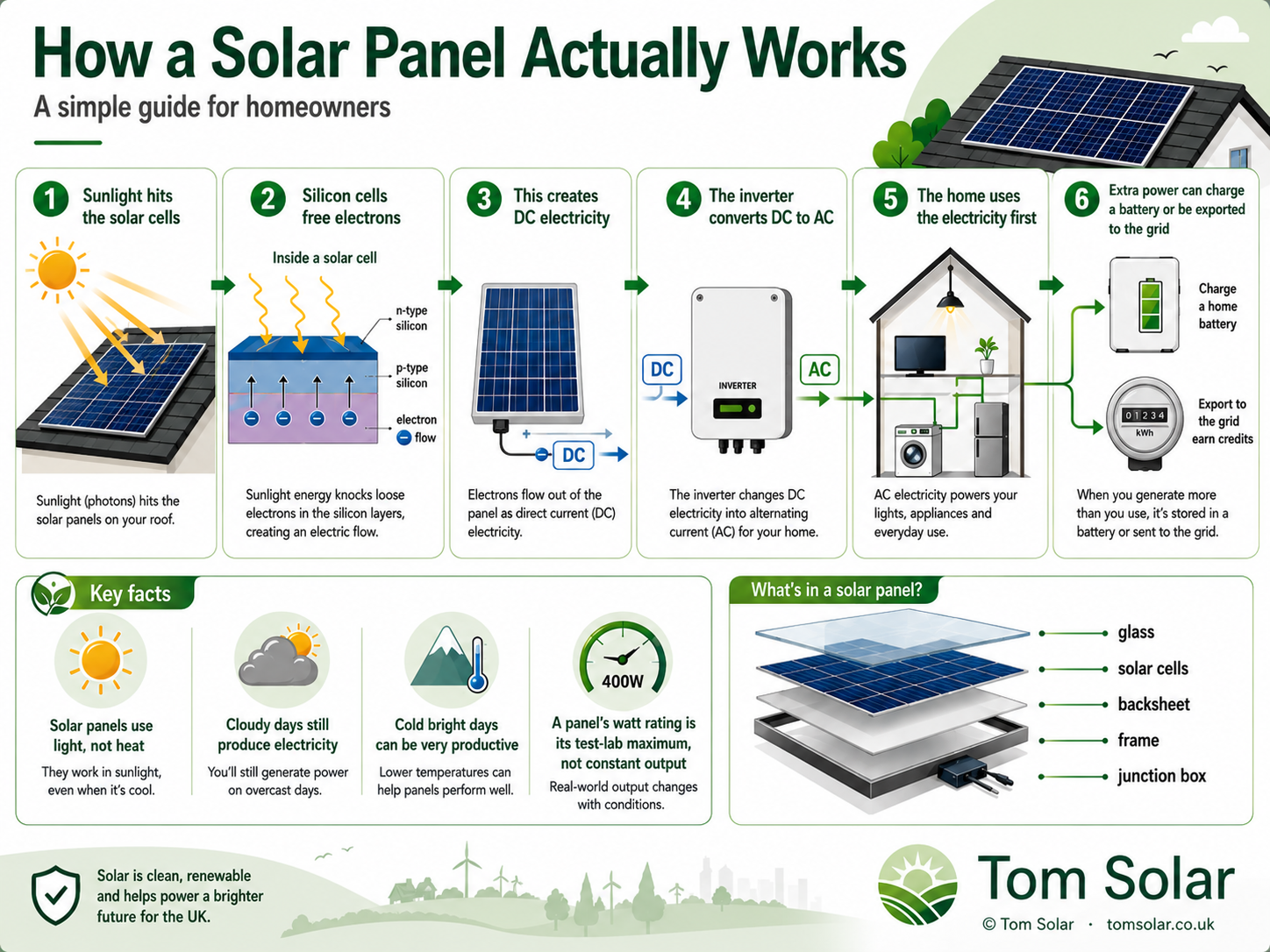
Inside the solar cell
Copper conducts electricity extremely easily.
Glass resists electrical conduction extremely well.
Silicon sits somewhere between those behaviours and is therefore called a semiconductor.
That gives engineers the ability to alter its electrical properties very precisely.
A photovoltaic cell is constructed so that different regions of the semiconductor have different electrical characteristics.
Modern solar cells use increasingly sophisticated architectures — including technologies such as TOPCon and heterojunction — but the central principle remains the same: light creates mobile charge carriers and the cell structure separates and collects them.
What light actually does
Light arrives in packets of energy called photons.
When a useful photon is absorbed by the semiconductor, its energy can allow an electron to move into a higher-energy state.
In semiconductor language this creates mobile charge carriers: an electron and what is described as a hole.
The cell's internal electric field helps separate those charges before they simply recombine.
Why electricity appears at the wires
The photovoltaic cell has conductive contacts that collect the electrical charge.
Connect an external electrical circuit and the available charge can flow through that circuit.
That movement of charge is an electrical current.
The voltage created across the cell provides the electrical potential that drives the current through the connected load.
It is converting incoming light energy into electrical energy as the light arrives. A battery is a separate device used when we want to store energy for later.
Cell → panel → string → array
The individual photovoltaic device that converts light into DC electrical energy.
Many cells are electrically connected and sealed into a durable weather-resistant module.
Multiple panels are connected electrically so their combined voltage and current can be handled by the inverter.
The complete collection of panels installed on the property.
Why connect cells together?
Individual cells are combined because a useful household solar system needs considerably more voltage and power than one cell can provide.
Connecting photovoltaic devices in series increases voltage.
Parallel electrical paths can increase available current.
Module designers combine cells into an electrical arrangement that creates a practical panel voltage and current.
Installers then connect suitable panels into strings that operate within the inverter's permitted electrical range.
The panels also have to form electrically sensible strings for the inverter and its MPPT inputs.
DC electricity
Solar panels produce direct current — DC.
The electrical polarity has a defined direction.
Normal British household electrical systems use alternating current — AC.
AC repeatedly changes direction and the UK grid operates at a nominal 50Hz frequency.
The inverter
Its most obvious task is converting DC electricity from the panels into AC electricity.
But a modern solar inverter also monitors and controls the electrical operating point of the array.
Among other tasks, depending on the equipment, it can:
The process of continually finding the useful electrical operating point of the solar array is called Maximum Power Point Tracking — MPPT.
Follow one unit of solar electricity
Suppose the solar system is currently generating 3kW and the house is consuming 2kW.
The solar generation means the property does not need to import that 2kW from the grid at that moment.
Approximately 1kW of surplus remains, before allowing for losses and any system-control behaviour.
That surplus might then charge a battery or flow out through the meter onto the grid.
Electrically, local generation reduces the net power the property needs from the network. If generation exceeds local demand, the net flow reverses and surplus power moves outward, unless storage or another controlled load absorbs it.
The wattage number
The rated wattage allows one panel to be compared fairly with another.
Manufacturers measure module performance under defined Standard Test Conditions — STC.
A 475W panel is therefore rated to produce 475 watts at its maximum power point under those standard conditions.
Real irradiance, cell temperature, sun angle, cloud, shading, inverter behaviour and other losses change continuously.
Solar needs light — not heat
This surprises many homeowners.
The energy source driving a photovoltaic cell is light.
Heating the panel does not make the photovoltaic effect stronger.
In fact, as the temperature of a conventional silicon cell rises, its voltage normally decreases enough that overall electrical power falls.
Manufacturers publish a temperature coefficient for their modules describing how rated power changes as cell temperature moves away from the reference condition.
What about Scotland?
Clouds scatter and absorb part of the incoming solar radiation.
That usually means less irradiance reaches the panel than under strong direct sunlight.
But plenty of daylight still reaches the roof as diffuse light.
The photovoltaic cells can still convert that light into electricity.
This is why Scottish solar systems generate throughout the year, although winter production is considerably lower because days are shorter, the sun is lower and weather conditions are generally less favourable.
Four different conditions
| Condition | What happens? |
|---|---|
| Bright and cool | Strong irradiance with relatively low cell temperature can produce excellent PV performance. |
| Bright and very hot | Irradiance may be excellent, but elevated cell temperature reduces voltage and therefore reduces power relative to the same irradiance at a cooler cell temperature. |
| Overcast | Diffuse daylight still generates electricity, but available irradiance and output are normally lower. |
| Heavy shade | Direct and diffuse light reaching affected cells is reduced and electrical interaction between connected cells can amplify the effect on part of the module or string. |
Shading
Cells inside a panel are electrically connected.
In a series electrical path, broadly speaking, the same current has to pass through each connected device.
A badly shaded cell can therefore restrict the current available through its part of the module.
That is why a chimney shadow, tree branch, dormer or heavy bird fouling can sometimes cause more loss than its physical size might suggest.
The electrical position of the shaded cells, module layout, bypass diodes, inverter MPPT behaviour and the rest of the string all matter.
Bypass diodes
Modern solar modules normally contain bypass diodes in the junction box.
Rather than placing one diode around every individual cell, the module is divided into electrical subsections.
If a subsection becomes sufficiently restricted, its bypass diode can conduct and provide an alternative path for current.
This helps reduce power loss and can reduce damaging reverse stress across shaded cells.
What's actually inside the module?
A rooftop module has to keep operating through decades of rain, frost, UV radiation, wind and temperature changes.
The finished construction therefore typically includes:
Many modern products are glass-glass modules, while others use a polymer backsheet. The exact construction depends on the panel.
Why are panels blue or black?
Light reflected away from the cell cannot be converted into useful electricity.
Solar cells therefore use surface texturing and anti-reflection treatments to encourage more useful light into the semiconductor.
Cell architecture, coatings, interconnection design and backing materials all influence whether a finished panel appears blue, dark blue or almost black.
Appearance alone tells you very little about the electrical performance, temperature behaviour, warranty or long-term quality of a module.
Panel efficiency
The sunlight arriving at a panel contains photons with a broad range of energies.
Not every photon has the right energy to create useful electrical charge in the semiconductor.
Some light is reflected.
Some absorbed energy becomes heat.
Some generated electrons and holes recombine before their charge can be collected.
Then there are additional electrical losses in contacts, wiring, power electronics and other parts of the complete system.
It does not tell us the annual generation of a roof by itself. Panel area, installed kWp, orientation, pitch, shading and location still matter.
Orientation
A photovoltaic cell simply responds to the light reaching it.
Orientation matters because it changes:
South-facing roofs normally maximise annual UK generation.
East- and west-facing arrays shift production toward morning or afternoon.
Even north-facing roofs can generate useful energy where roof pitch, installation cost and electricity value make the maths worthwhile.
What happens over 25 years?
Photovoltaic modules contain no rotating machinery.
But materials still age.
Long-term exposure to temperature cycles, moisture, UV radiation, mechanical loads and electrical operation gradually affects module performance.
This is why reputable manufacturers publish product warranties and performance warranties.
It normally describes a warranted minimum level of retained output after specified years. Actual module behaviour depends on the product and operating environment.
During a power cut
This catches many homeowners out.
A normal grid-tied solar inverter monitors the electricity network.
If the grid fails, the inverter stops energising the normal grid connection.
This anti-islanding behaviour protects people working on what should be a de-energised network.
Backup operation requires compatible equipment and a correctly designed emergency or backup supply arrangement that safely separates the backed-up circuits from the failed grid.
The panels themselves can still develop DC voltage whenever sufficient light reaches them, which is one reason solar electrical work must be carried out by competent people using appropriate isolation procedures.
The remarkable bit
The energy source reaches the roof as sunlight.
Electricity is produced directly through the photovoltaic effect.
Light drives the process and excessive cell temperature actually reduces electrical output.
Once commissioned, the electronics continuously manage generation as weather and household demand change.
Frequently asked questions
Sunlight transfers energy to charge carriers inside semiconductor solar cells. The cell structure separates those charges and electrical contacts collect them, creating DC electricity.
Light. Heat is not the fuel for a photovoltaic panel. Higher cell temperatures generally reduce the electrical power produced by conventional silicon modules.
Yes. Diffuse daylight still reaches the cells and can be converted into electricity. Output is normally lower than during strong direct sunshine.
It is the module's rated maximum-power output under standardised laboratory test conditions. It does not mean the panel continuously produces 475 watts whenever it is daylight.
The photovoltaic cell creates a fixed electrical polarity, so the collected charge flows through the external circuit as direct current.
Household circuits use AC electricity. The inverter converts the panels' DC output into AC at the correct electrical conditions for the home and grid connection.
Cells are the individual photovoltaic devices. Cells are combined into panels. Panels can be electrically connected into strings. The complete collection of installed panels is the array.
Cells are electrically interconnected, so a shaded cell can limit current through part of the module. Bypass diodes help route current around affected groups of cells but cannot remove the shading loss.
For the same amount of sunlight, silicon PV modules generally produce more power when their cells are cooler than when they are very hot.
Solar generation reduces the home's instantaneous grid import. Surplus electricity can then charge compatible storage or flow out through the meter to the grid.
Not with an ordinary grid-connected installation. Backup requires compatible inverter, switching and electrical equipment designed specifically to supply selected circuits safely during an outage.
Output normally degrades gradually over many years rather than the panel suddenly stopping at the end of its warranty. Product and performance warranties should be checked for the specific module.
Technical basis checked
This guide was reviewed against established photovoltaic information available in August 2026 including:
Solar-module construction and electrical characteristics vary by manufacturer and cell technology. Product datasheets, installation instructions and the final system design take precedence over the simplified examples used in this homeowner guide.
Related Tom Solar guides
Tom Solar view
The panel is not complicated machinery.
It is a carefully engineered semiconductor device turning light directly into electrical energy.
From there, good solar design is largely about making sure that electricity can be generated, converted, stored and used efficiently.
That means the panel cannot sensibly be considered on its own.
The quality of the final result comes from designing all the parts around the property and the people who live in it.