East-facing string
Connect the east-facing modules to one suitable MPPT so they can follow their own sunlight pattern.

Solar shading and optimisation explained
Sometimes they are extremely useful.
Sometimes a well-designed conventional string system will perform perfectly well without them.
The important question is not whether optimisers are “better”. It is whether your particular roof gives them a problem worth solving.
The short answer
If every panel faces substantially the same direction, has similar sunlight and is correctly connected to an appropriate inverter MPPT, a conventional string inverter can be a very efficient and elegant solution.
Optimisers become more interesting when panels behave differently.
“More electronics must be better” is not, by itself, a design calculation.
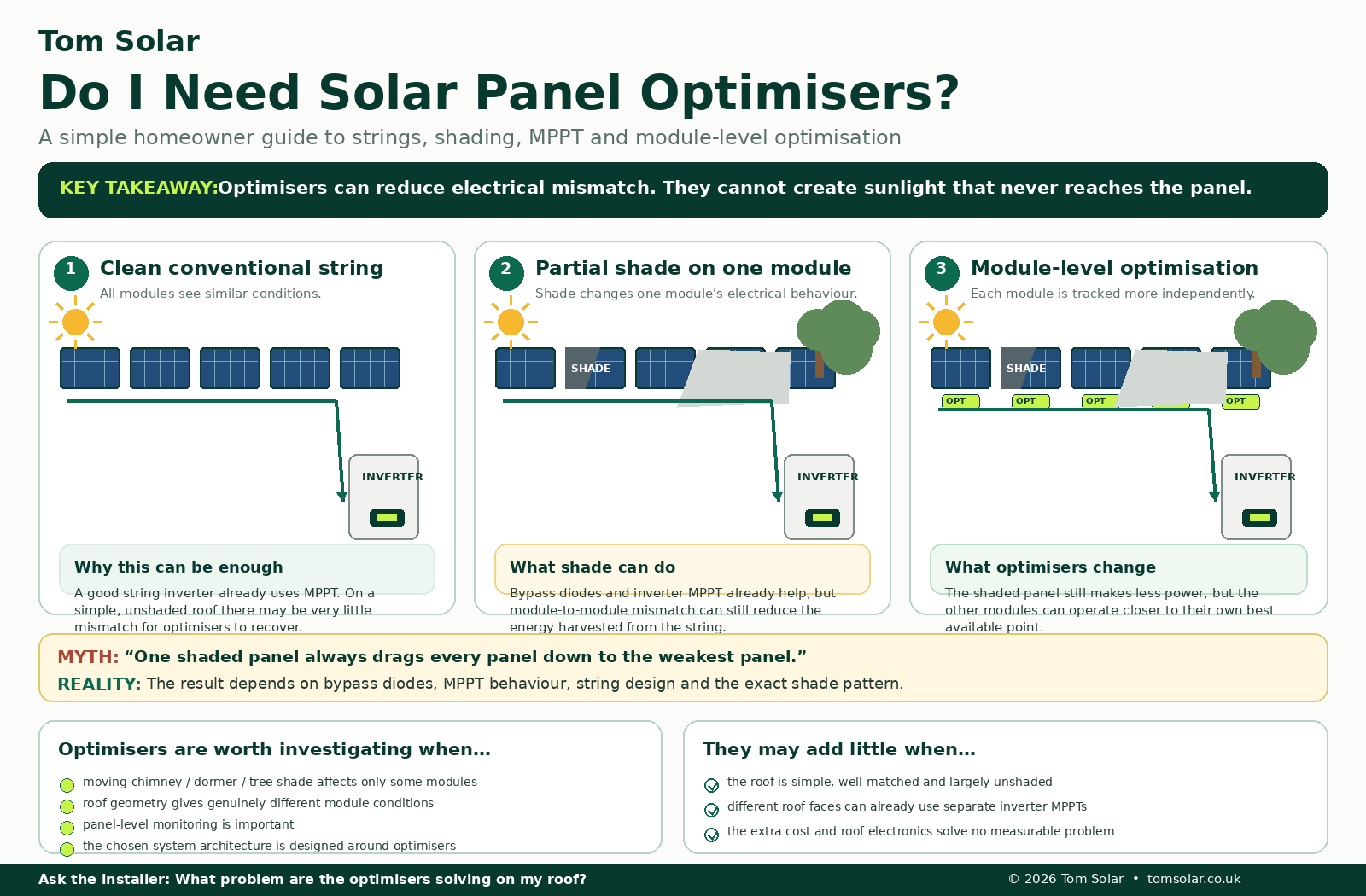
Tom Solar visual guide
What an optimiser actually does
Every solar module has a combination of voltage and current at which it can produce its best available power at that moment.
That operating point changes with:
An optimiser performs Maximum Power Point Tracking at or near module level.
It electronically adjusts the module's DC output so that it can operate more independently from other modules in the string.
First understand the ordinary inverter
Most modern string inverters contain one or more MPPTs.
MPPT means:
The inverter continually searches for the voltage and current combination at which the connected solar string can deliver its best available power.
This means an ordinary string system is not electrically stupid.
A good designer can often separate different roof conditions using different MPPT inputs.
A simple example
Connect the east-facing modules to one suitable MPPT so they can follow their own sunlight pattern.
Connect the west-facing modules to another MPPT so their different afternoon operating conditions do not have to be forced into the same electrical string.
The number of MPPTs, allowed string voltages and current limits can affect whether optimisers add genuine value.
The shading myth
You will hear that phrase frequently in solar sales.
It contains a useful warning about mismatch — but electrically it is too crude to be treated as a universal rule.
The real behaviour depends on:
Bypass diodes
A modern module is usually divided electrically into groups of cells.
Bypass diodes can allow a badly restricted cell group to be bypassed instead of forcing the entire module current through that affected section.
This can:
When a section is bypassed, that section's normal voltage and power contribution are largely lost.
Where optimisers genuinely help
Where they may add little
Imagine:
There may simply be very little module mismatch for optimisers to recover.
Optimisers do not fix bad solar design
This distinction matters.
An optimiser may reduce the knock-on effect that a shaded module has on other modules.
It cannot make the shaded module receive sunlight that is physically blocked.
If a module will sit in deep, persistent shade for a substantial part of its useful generation period, removing it from the design may be better than adding electronics to justify it.
Three common approaches
| System type | Where MPPT happens | Advantages | Considerations |
|---|---|---|---|
| Conventional string inverter | At string / inverter MPPT level. | Simple architecture, fewer roof electronics, excellent for well-matched strings. | Module mismatch can matter more where shading or roof geometry is complex. |
| DC optimiser system | At or near module level, feeding a string inverter. | Can reduce mismatch losses, allow detailed monitoring and provide greater design flexibility. | Adds cost, connectors and electronics beneath the modules. |
| Microinverters | At module level. | Each module operates independently and produces AC at the roof. | One inverter-type electronic device is installed beneath each module and system architecture differs substantially from a central inverter. |
Monitoring
A conventional inverter usually tells you how a string or whole array is performing.
Module-level monitoring can show individual panels.
That can help identify:
The trade-off
Good quality module-level electronics can carry substantial warranties and have excellent reliability.
But the system designer should still acknowledge the physical reality:
The best design is not necessarily the one with the fewest components or the most components. It is the one that uses the components the property genuinely benefits from.
Safety features
Certain module-level systems include shutdown features designed to reduce DC voltage when the inverter or grid is switched off.
That can be useful for:
These features are product- and system-specific. The inverter, optimiser and installation architecture must be assessed as one complete system.
Shading must still appear in the numbers
Current MCS requirements require predicted PV generation to account for shading.
Where shading is present, the customer should be told that the shading reduces system output and the performance estimate should include an appropriate shade factor or another compliant methodology.
A better buying question
If an installer recommends optimisers, ask them to show you:
And that is exactly what it should be.
A quick decision guide
| Roof situation | Optimisers? | Reason |
|---|---|---|
| Simple south-facing roof, little or no shade | Often unnecessary | Panels already operate under very similar conditions. |
| East and west roofs with suitable separate MPPTs | Not automatically required | The inverter can already keep the roof faces electrically separate. |
| Moving chimney shade across a few panels | Worth investigating | Module mismatch may create recoverable losses. |
| Several roof orientations but too few MPPT inputs | Potentially valuable | Module-level control can provide greater design flexibility. |
| Permanent deep shade | Do not assume an optimiser solves it | The panel may simply receive too little useful sunlight. |
| Owner wants detailed panel-by-panel diagnostics | Stronger case | Module-level monitoring can be genuinely useful over the system lifetime. |
Frequently asked questions
Not necessarily. They are most useful when individual modules experience materially different operating conditions or when module-level monitoring or system-specific safety functions are valuable.
It performs module-level power tracking and conditions the DC output so the connected module can operate more independently from the rest of the string.
They can reduce mismatch losses caused by partial shading, but they cannot replace the sunlight physically blocked from the shaded panel.
Shade can affect the string, but the result depends on bypass diodes, MPPT behaviour, string configuration and the exact shade pattern. The familiar “weakest panel controls everything” explanation is too simple.
They allow heavily restricted sections of a module to be bypassed electrically, helping the remaining sections continue operating.
Maximum Power Point Tracking continually adjusts voltage and current so the connected solar source operates around its best available power point.
In many straightforward multi-orientation designs, yes. Different roof faces can often be placed on separate MPPT inputs.
No. Optimisers condition DC electricity before a central inverter. Microinverters convert DC to AC at module level.
Many optimiser systems provide module-level monitoring, although exact features depend on the manufacturer and installation.
They add roof-mounted electronics and connections. That does not mean they are unreliable, but it is a legitimate lifetime-design consideration.
It depends on the chosen system. Some architectures require optimisers throughout the array; others can use module-level devices selectively. Manufacturer rules must be followed.
They can reduce mismatch loss, but they cannot produce useful quantities of energy from a panel that receives very little light. Sometimes the correct answer is to leave that panel out.
It depends on the fault and the system design. A bypass diode may allow part of the module to be bypassed, while an optimiser or microinverter system may isolate the loss more visibly at module level. A conventional string can continue operating, but its output may be reduced. Monitoring data and electrical testing are needed to distinguish a failed module from shading, a connector fault or another string problem.
Evidence checked
This guide was reviewed against current and established material including:
Exact optimiser behaviour, compatibility, monitoring, safety features and permitted string design depend on the products selected. Manufacturer design rules and property-specific electrical calculations always take precedence over simplified examples in this homeowner guide.
Related Tom Solar guides
Tom Solar view
Optimisers are clever technology.
On the right roof they can be extremely useful.
But the justification should be visible in the design:
And “you need optimisers because they are better” stops being good enough.