Import capacity
This is how much electricity the property connection can take from the network.
Upgrading to three phase can substantially increase the total power potentially available to the property.

Home electricity connections explained
Three phase can give a home substantially more electrical capacity, make larger solar and battery systems easier to accommodate and open the door to more powerful EV charging.
But there is a catch: upgrading the supply can be expensive, and having three phases does not automatically mean the electricity network will let you export as much solar as you want.
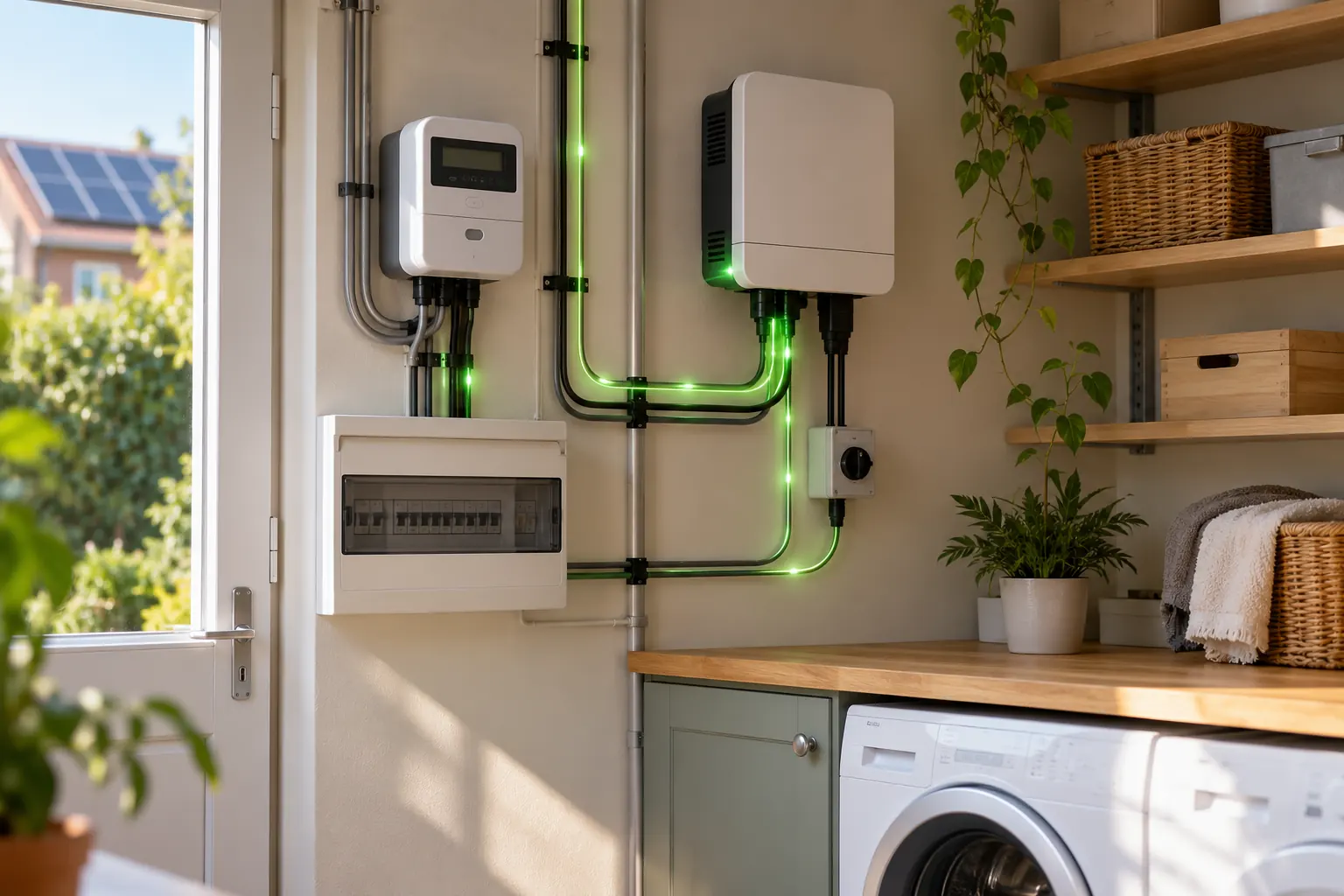
The short answer
Most British homes have historically been supplied with single-phase electricity.
For an ordinary household with conventional appliances, that has generally been more than adequate.
But homes are changing.
For some properties, three phase provides useful capacity and room for future growth.
If your main reason for upgrading is to obtain more solar export capacity, establish what the local Distribution Network Operator is likely to permit first. Three phase does not automatically guarantee a larger export allowance.
Start with the basics
A normal single-phase household connection has one live electrical phase feeding the property.
That one phase supplies the consumer unit, sockets, lighting and other household electrical equipment.
For decades that was entirely sensible.
A house might have had a cooker, kettle, washing machine, television and lighting, with gas dealing with space heating and often hot water.
Today that same service may be asked to support:
What changes?
This allows electrical loads and generation to be distributed across three phases rather than concentrating everything on one.
Three phase has been normal in commercial and industrial buildings for many years because those properties often require considerably more power.
As homes electrify, it is becoming increasingly relevant domestically too.
Solar makes this interesting
G98 applies to qualifying fully type-tested microgeneration up to 16 amps per phase.
On a single-phase supply, 16 amps at nominal UK voltage corresponds to approximately:
On a qualifying three-phase installation the equivalent aggregate figure is approximately:
That is three times the single-phase figure because the generation is spread across three phases.
Important qualification
The 16A-per-phase threshold tells you whether qualifying generation can fall within the G98 framework.
It does not override:
It does not remove the need for proper system design or network compliance.
Import versus export
This is how much electricity the property connection can take from the network.
Upgrading to three phase can substantially increase the total power potentially available to the property.
This is how much generation the DNO agrees the property may send back onto the network.
Export capacity depends on local network conditions as well as the property's own connection.
The crucial solar question
It may help — but it cannot be promised.
Imagine a homeowner currently has single phase and wants a large solar-and-battery system.
Moving the property to three phase may remove one constraint because the generation can now be distributed across three phases.
But the DNO still has to assess:
If the objective is a particular solar export capacity, seek the DNO's position before committing to the supply upgrade wherever practicable.
A useful example
A property may want 8–12kWp or more of solar generation rather than designing everything around a 3.68kW single-phase inverter.
Larger hybrid or battery inverters may be capable of several kilowatts of charging and discharging.
Two electric vehicles can create substantial overnight or daytime charging demand.
Heating adds another significant electrical load, especially during cold weather.
None of these automatically requires three phase individually.
It is the combination that can make the upgrade increasingly sensible.
Electric vehicles
Potentially.
The familiar domestic EV charger is around 7kW and normally operates from a single phase.
Three-phase installations can also support higher-power charging arrangements such as approximately 11kW or 22kW where:
There is little benefit in paying for a 22kW charger if the vehicle itself can only accept 7kW or 11kW AC.
Heat pumps
Usually not by itself.
Many domestic heat pumps are designed to work perfectly well from a conventional single-phase household supply.
Three phase becomes more relevant where:
A house containing 30kW worth of appliances does not necessarily draw 30kW continuously. Proper maximum-demand calculations and load management can sometimes avoid an unnecessary connection upgrade.
The expensive bit
The answer depends on one very simple question:
If suitable three-phase infrastructure already exists immediately outside the property, the job may involve a relatively short new service connection and alterations around the meter position.
But that is the easy case.
A more difficult property might require:
A real network example
SSEN's published connection-charging methodology gives an example of a domestic property requesting a three-phase connection where the local infrastructure only provides single phase.
In that example, supplying three phase requires:
That illustrates why quotations can vary so dramatically between apparently similar houses.
It is “What network construction work is necessary to deliver those phases to this property?”
There is no useful universal price
Three-phase domestic upgrades are generally chargeable.
The actual DNO quotation depends on the work required.
An Energy Networks Association innovation project examining domestic three-phase upgrades used a conventional upgrade cost range of around £3,500–£6,000 as a modelling assumption.
That is useful context — but not a price list.
Where substantial reinforcement is needed, individual quotations can be significantly higher.
A modest upgrade may make perfect economic sense. A network-reinforcement project costing many thousands of pounds can completely change the calculation.
Another complication
The DNO owns and controls the incoming network service and cut-out.
Your electricity supplier is responsible for the meter.
The homeowner's electrician deals with the customer's own electrical installation.
A three-phase upgrade can therefore involve coordination between several parties.
The DNO quotation is therefore not necessarily the total cost of converting the property.
Do I already have it?
The meter and cut-out area often gives the answer.
A conventional single-phase connection typically has one live phase and one main DNO fuse.
A three-phase installation normally has three live phases and corresponding service equipment.
The DNO or a qualified electrician can confirm the supply safely. Network records and the MPAN can also help establish the existing connection.
When I would seriously consider it
You genuinely need substantially more generation and inverter capability than a small single-phase arrangement provides.
The household has, or expects to have, several electric vehicles and significant charging demand.
The home is moving a large proportion of its energy demand from fossil fuels onto electricity.
High-power battery charging and discharging forms part of the long-term energy design.
The property also has motors, machinery or equipment that genuinely benefits from three-phase supply.
The household expects to remain in the property and benefit from the additional electrical capability for many years.
When I would hesitate
A conventional single-phase connection is still perfectly adequate for huge numbers of British homes.
I would question the upgrade where:
Future-proofing
Potentially.
A three-phase connection can give a property greater flexibility for future electrification.
A later homeowner may want:
Having suitable three-phase infrastructure already established can therefore be a practical property advantage.
Three phase should be viewed primarily as increased electrical capability, not marketed as a guaranteed investment return.
Before applying
The sensible sequence is:
It should not be the starting assumption simply because a larger number sounds more future-proof.
Frequently asked questions
Single phase gives a normal domestic property one live phase. Three phase provides three live phases, allowing demand and generation to be spread across them and potentially providing substantially greater total electrical capacity.
Potentially yes. It can make larger generation arrangements easier to accommodate and allows generation to be distributed across three phases. The DNO still controls the connection and permitted export.
G98 covers qualifying fully type-tested microgeneration up to 16 amps per phase. At nominal UK voltage that corresponds to approximately 3.68kW single phase or 11.04kW aggregate across a qualifying three-phase installation.
No. Import capacity and export capacity are different. The DNO still assesses local voltage, cables, transformers and existing generation before agreeing the requested export.
DNOs commonly offer domestic and small-business three-phase connections up to around 69kVA, subject to the local network and requested connection capacity.
It can be. Three-phase upgrades are generally chargeable. If the local network already has suitable three-phase infrastructure, the work may be relatively straightforward. If cables, transformers or other network assets require reinforcement, the cost can become substantial.
Potentially. Three phase can support higher-power EV charging where the vehicle, charger, household installation and DNO connection capacity all permit it.
Most ordinary domestic heat pumps do not require it. Three phase becomes more relevant where total household electrical demand is high or several large electrical technologies are being combined.
Not universally. The correct answer depends on the inverter, property connection and DNO requirements. At higher domestic generation levels, a three-phase arrangement may be preferred or required.
The meter and cut-out arrangement often shows the number of phases, but the safest approach is to have the supply confirmed by a qualified electrician or the DNO.
Not without checking the network position first. Three phase does not guarantee a particular export allowance, so establish what the DNO is likely to permit before paying for the upgrade.
It can be. Additional connection capacity may be useful for future solar, batteries, EV charging, heat pumps and other electrical equipment, particularly where a household expects continuing electrification.
Official guidance checked
This guide was reviewed against current material available in August 2026 including:
Every property and local network is different. The current DNO connection offer and relevant engineering requirements take precedence over this general homeowner guide.
Related Tom Solar guides
Tom Solar view
Three phase can be an excellent upgrade for the right property.
A heavily electrified home with substantial solar, battery storage, EV charging and electric heating may genuinely benefit from the additional capacity and flexibility.
But upgrading purely because a larger electrical connection sounds impressive can be an expensive mistake.
And if solar export is the reason for the upgrade, check the DNO position before assuming the extra phase capacity will translate into the export allowance you want.