Lighting
Modern LED lighting typically uses relatively little power and can be extremely useful during an outage.

Solar backup and power cuts explained
It is a perfectly reasonable question: if the sun is shining and your roof is generating electricity, why should your house go dark when the grid fails?
The answer is safety. An ordinary grid-connected solar inverter deliberately stops supplying the grid during a power cut. Keeping your home powered requires a different, carefully designed backup mode.
The short answer
During a normal power cut the electricity network disappears from the inverter's point of view.
The inverter detects that loss of mains and stops feeding its normal grid-connected AC output.
The panels on the roof may still be exposed to daylight and may therefore still have DC voltage present.
It is the safe connection between the solar system and the normal household/grid AC system that has deliberately been interrupted.
Tom Solar visual guide
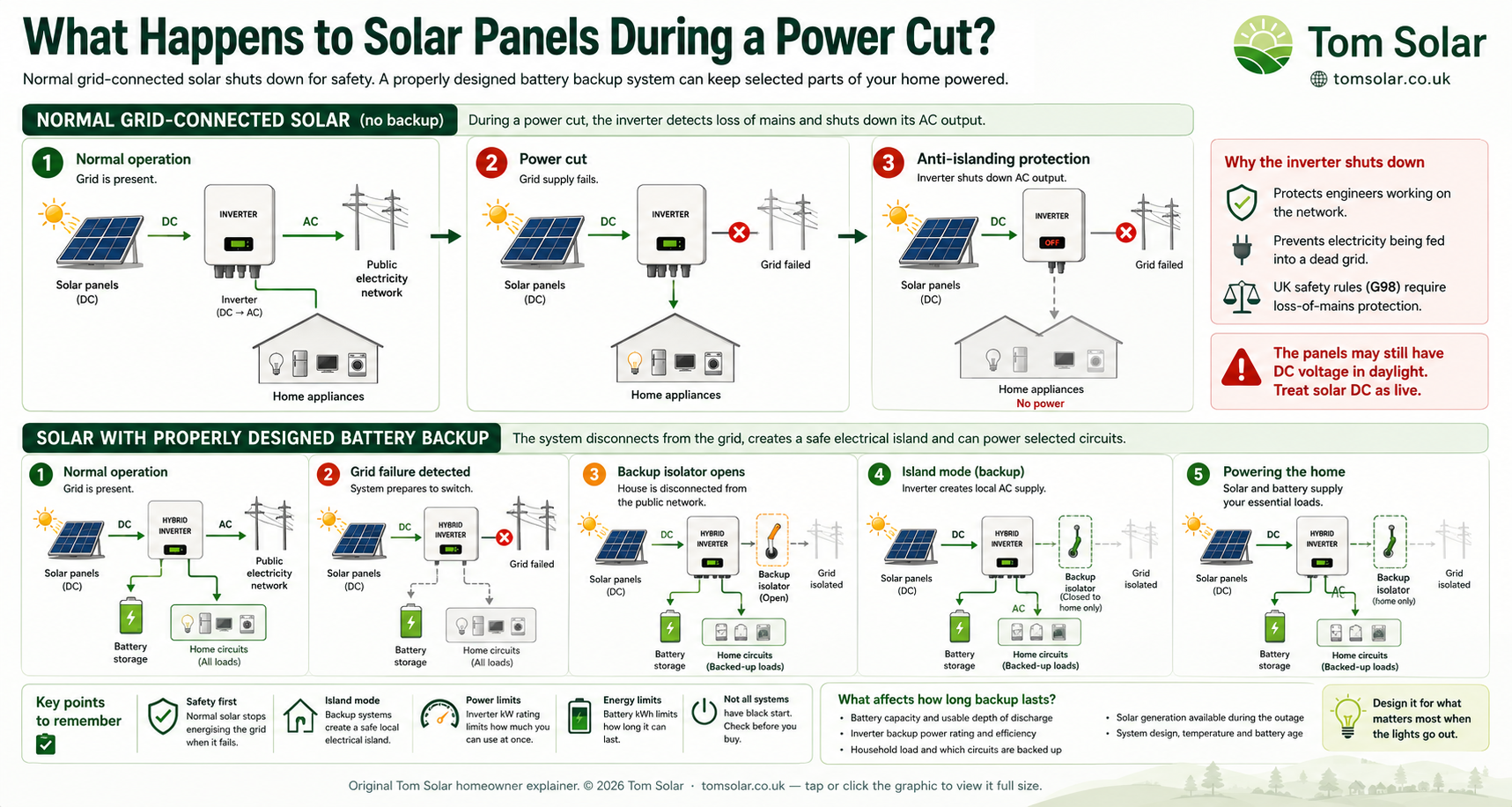
Why shut the inverter down?
Imagine a storm damages an electricity cable.
The network operator isolates the affected network so engineers can repair it.
If thousands of rooftop solar systems simply continued feeding power into those wires, the supposedly isolated network could remain dangerously energised.
That is why grid-connected generation incorporates loss-of-mains protection.
Anti-islanding
Under normal operation the inverter works in parallel with the grid.
It monitors electrical conditions such as voltage and frequency.
If the network disappears or moves outside the permitted operating conditions, the system's interface protection disconnects generation from the distribution network.
It prevents an ordinary grid-connected inverter from accidentally creating its own uncontrolled electrical island on the public network.
Important safety point
Photovoltaic cells produce electrical voltage when exposed to sufficient light.
Switching off the grid or isolating the inverter's AC connection does not magically stop sunlight reaching the modules.
Electrical work on a PV installation should be carried out using appropriate isolation procedures by people competent to work on solar DC systems.
So how can backup work?
A deliberately designed backup system behaves differently from ordinary grid-connected solar.
When the public network fails, suitable switching isolates the backed-up electrical installation from the grid.
Compatible power-conversion equipment can then establish the voltage and frequency required to supply selected household circuits.
Normal mode versus island mode
| Normal grid operation | Island / backup operation |
|---|---|
| House is electrically connected to the public network. | Backed-up circuits are electrically separated from the public network. |
| Grid establishes normal system voltage and frequency. | Suitable backup power-conversion equipment establishes the local supply. |
| Grid can supply loads beyond the inverter's own output. | Loads are limited by backup inverter power and available stored/generated energy. |
| Surplus solar can normally export. | There must be no export into the failed public network. |
A battery is not enough
The battery is simply the store of energy.
Backup operation also depends on:
Never assume one automatically gives you the other.
EPS
Manufacturers frequently use the term EPS — Emergency Power Supply.
The exact meaning varies between products.
It might describe:
Ask exactly what is powered, at what maximum output, for how long, and what happens automatically when the grid fails.
Essential loads
Modern LED lighting typically uses relatively little power and can be extremely useful during an outage.
Keeping food refrigeration alive is often far more valuable than trying to run every appliance in the property.
Router, phone charging and selected sockets can keep the household connected.
Depending on the heating system, keeping controls or circulation equipment alive may be important.
Whole-house backup
When connected to the grid, the house can draw power from the grid whenever household demand exceeds solar and battery inverter output.
During island mode that safety net has disappeared.
The backup inverter has a finite output.
That is determined by the inverter's backup output, battery discharge capability and system design.
kW versus kWh — again
kW is power.
It limits how much electrical load the backup inverter can support at a moment.
kWh is energy.
It determines how much stored energy is available before the battery reaches its permitted discharge limit.
Simple illustration
Ignoring conversion losses and reserve limits for simplicity:
But if the household suddenly attempts to draw 8kW, a 5kW island-mode inverter cannot simply supply it merely because plenty of energy remains in the battery.
Can solar keep generating?
Once the property has been safely isolated from the public network, suitable equipment can create a local AC electrical system.
Depending on the architecture, compatible solar generation may then continue operating inside that local island.
Solar could:
If the battery is full and the house is consuming little power, the system cannot export excess electricity into a dead public network. Compatible controls must reduce or stop generation as required.
Black start
This is where system capability becomes particularly important.
Some equipment supports what is commonly called black start.
That means the system can establish or re-establish its local electrical supply without first relying on the public grid.
Other systems may require sufficient battery state of charge, a live grid reference or a particular startup sequence.
This is an equipment-specific feature and should be checked before purchase.
Automatic changeover
Possibly.
Some backup systems change operating mode very quickly.
Others have a noticeable interruption while switching.
The exact transfer time depends on the equipment and system architecture.
If equipment genuinely cannot tolerate even a brief interruption, check whether the proposed system meets the required continuity standard rather than assuming any battery backup behaves like a UPS.
EV chargers
A normal single-phase EV charger may draw around 7kW.
That is larger than the total island-mode output of many domestic battery inverters.
Even where the inverter could support it, using precious backup energy to charge a vehicle may make little practical sense during an outage.
Keep the lights, fridge, communications and genuinely important household services running instead.
Heat pumps
A heat pump can be a significant electrical load.
Its backup suitability depends on:
A system that comfortably runs the heat-pump compressor may not necessarily support several kilowatts of auxiliary electric heating as well.
Earthing and protection
The normal electricity network forms part of the property's electrical protection and earthing environment.
Once an installation deliberately operates as an island, the designer must ensure that protective measures still operate correctly.
Current MCS battery-storage requirements include specific provisions for:
It needs to be designed and installed as such.
When the grid comes back
Grid-connected equipment monitors the restored electricity network.
Before normal parallel operation resumes, the system must see acceptable network conditions and satisfy its protection and reconnection requirements.
A backup-capable installation then leaves island mode and returns to its normal grid-connected operating state.
Exact behaviour varies between manufacturers and system architectures.
Questions worth asking before buying
One socket, selected circuits or the majority of the house?
The normal grid-connected inverter rating and island-mode rating are not always identical.
Ask whether PV continues supporting loads and battery charging during an outage.
Ask what happens if the battery reaches its minimum state of charge overnight.
Determine whether sensitive equipment will experience an interruption.
EV chargers, showers, ovens, immersion heaters and heat pumps may need special treatment.
Frequently asked questions
The panels can still develop DC voltage in daylight, but an ordinary grid-connected inverter stops supplying its normal AC output when the public network fails.
Loss-of-mains protection prevents local generation from continuing to energise a public network that should be isolated.
It is protection that disconnects local generation from the public network when the network supply disappears.
Not automatically. Backup requires compatible inverter equipment, switching, isolation, earthing, protection and a system designed for island operation.
It commonly means Emergency Power Supply, but exactly what the EPS output can supply varies significantly between manufacturers.
Potentially, but the design must stay within backup inverter power, battery discharge capability and stored-energy limits. Large loads may need to be excluded.
Some systems can. It depends on the inverter architecture, system compatibility and the controls available in island mode.
It is the ability of compatible equipment to establish or re-establish a local islanded electrical supply without first relying on the public grid.
Only if the backup installation was designed for such a large load. EV charging is often deliberately disabled during a domestic outage.
It may be possible where the inverter and battery can support its running and starting requirements, but it should be deliberately assessed rather than assumed.
Not necessarily. Some home battery systems have a transfer delay. Equipment requiring truly uninterrupted power should have its continuity requirements checked separately.
The inverter monitors the restored network and reconnects only after acceptable conditions and its required reconnection process have been satisfied.
Technical basis checked
This homeowner guide was reviewed against current material including:
Backup capability varies substantially between manufacturers and installation architectures. Product documentation and the design of the specific electrical installation take precedence over the simplified homeowner examples used here.
Related Tom Solar guides
Tom Solar view
This is one of those subjects where a customer's perfectly reasonable assumption can be completely different from what the equipment actually does.
“Solar plus battery” sounds like a house that keeps running through a blackout.
Sometimes it does.
Sometimes it powers only one emergency socket.
Sometimes it has no blackout functionality at all.
Then the switching, backup power, battery capacity and essential circuits can be designed around that requirement instead of being discovered after installation.
Before thinking about backup equipment, start by finding out what your roof can realistically support. I'll check it free.
Check My Roof FreeScottish homeowners only · No obligation · No sales call required
A large EV battery can hold substantial energy, but V2L, V2H and V2G have different requirements. Our illustrated guide explains vehicle compatibility, driving reserves and the equipment needed during a genuine power cut.
Can my electric car power my house during a power cut? Explore the guide and backup calculator →