V2L: vehicle-to-load
Car → appliance
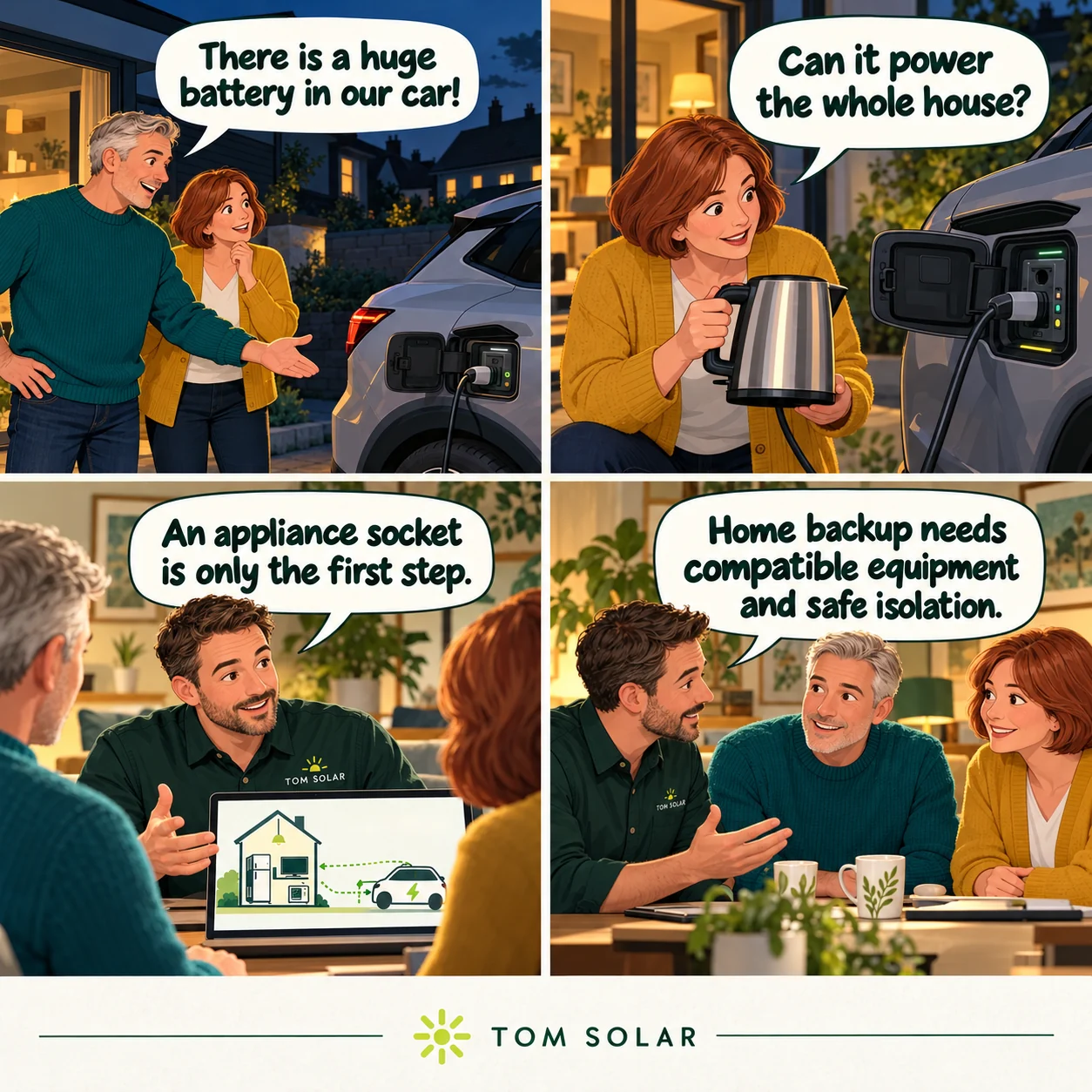
An outlet or adapter powers suitable appliances within its rated output. It can be useful for emergency essentials, but does not establish support for supplying your home's fixed wiring.

Power-cut protection · Electric cars · Scottish homes
There could be days of energy sitting on your driveway. Turning it into dependable home backup takes the right car, the right equipment and a plan for the electricity you actually need.
Research checked: 9 October 2026 · UK buying guide
A large electric-vehicle battery can hold several times the energy of a typical home battery. If your car and installation support vehicle-to-home backup, that energy could keep essential circuits running much longer during an outage.
However, a car that can charge in both directions, power a kettle or sell electricity to the grid is not automatically a car that can keep your house running when the grid fails. The complete arrangement matters.
“Will this exact UK vehicle and equipment combination supply these home circuits during a genuine grid failure—and who confirms that in writing?”
Car → appliance
An outlet or adapter powers suitable appliances within its rated output. It can be useful for emergency essentials, but does not establish support for supplying your home's fixed wiring.
Car → installed system → home
Compatible equipment supplies the home. Check whether that means normal on-grid use, actual power-cut backup, or both. Those capabilities must be stated separately.
Car ↔ grid
The vehicle imports and exports electricity through a supported arrangement. A V2G tariff or export approval does not, by itself, confirm operation when the network goes down.
For example, Hyundai describes the IONIQ 5's V2L function as providing up to 3.6 kW for appliances. That is a useful facility, but it is not evidence of an approved UK whole-home backup installation. Hyundai's explanation.
Do not connect an appliance outlet to a household wall socket to energise the house. Fixed-wiring backup needs a properly designed installation. Ask a qualified installer about any proposed use of V2L with dedicated changeover equipment.
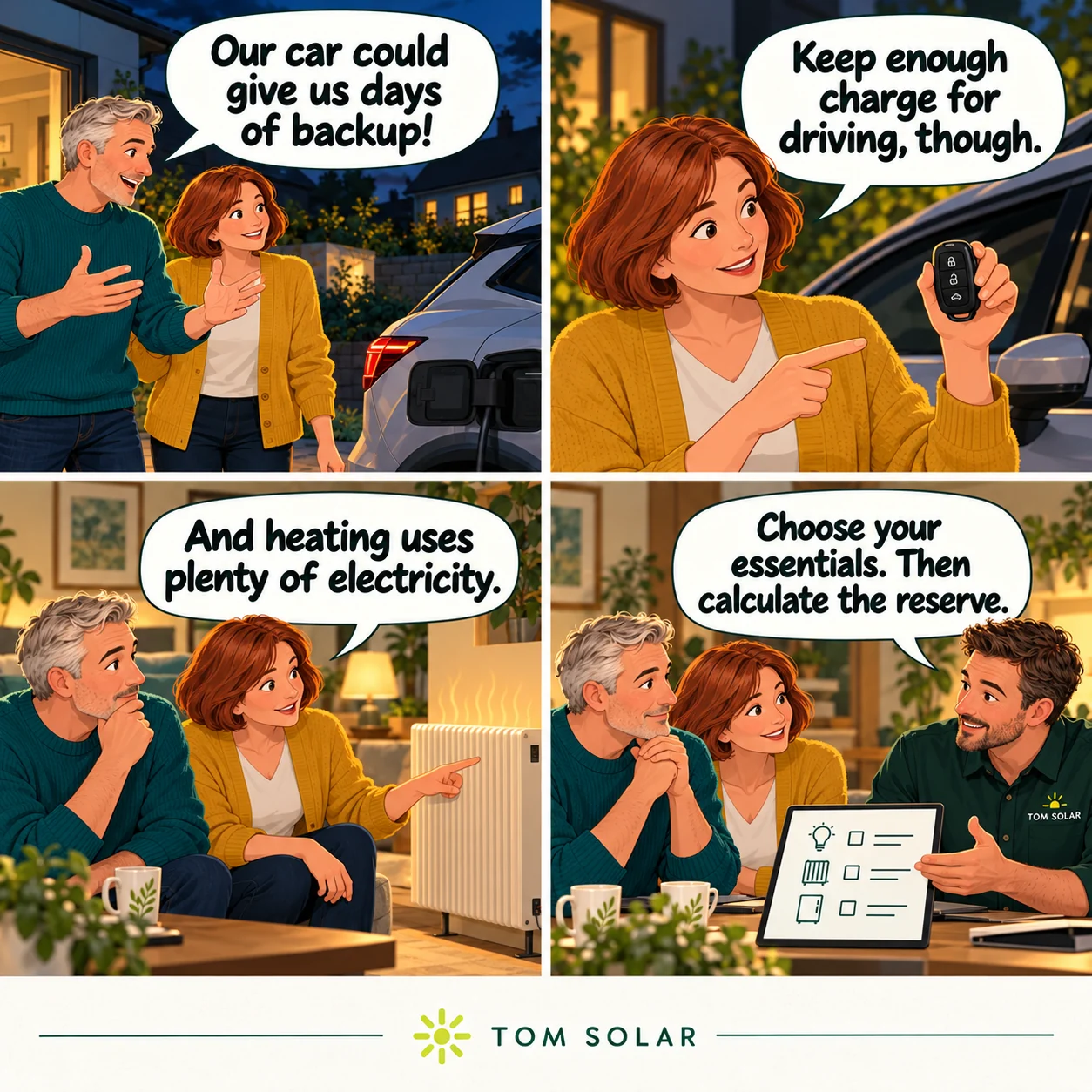
Yes, the capacity maths can be encouraging. Start with the car's usable battery capacity, deduct the charge you need to keep for driving, then allow for conversion losses. Divide the remaining household energy by the electricity you expect to use each day.
Starting at 100% charge, keeping a 20% driving reserve, and assuming 90% conversion efficiency:
75 × (1.00 − 0.20) × 0.90 = 54 kWh available to the home.
This is an illustrative energy calculation. It does not establish vehicle compatibility or guarantee real-world duration.
Use usable capacity, your likely starting charge and the reserve you want to protect. Efficiency is an assumption; ask your installer for the proposed system's figures.
Illustration only. No solar replenishment, additional home-battery energy or standby consumption is included.
Starting charge matters enormously. The same 75 kWh battery beginning at 80%, with a 20% reserve and 90% efficiency, leaves 40.5 kWh for the house. Beginning at 60% leaves 27 kWh. If the car is away when the power fails, its energy is away too.
kWh tells you how much energy is stored. kW tells you how much power can be delivered at once. A large battery still cannot supply appliances beyond the backup system's output limit. A 9 kW shower, for instance, exceeds a 3.6 kW appliance outlet regardless of battery size.
For emergency use, plan around lights, refrigeration, communications and suitable heating controls first. Check starting surges and whether the system can support the boiler or heat pump. “Five days of essentials” and “five days of unrestricted normal living” are very different proposals.
The evidence needs three separate checks: what the vehicle supports, what the equipment can do, and whether that exact combination is available and approved for your UK installation. The examples below are not a universal compatibility list.
Manufacturer-confirmed capabilities, overseas products and independent field tests are different kinds of evidence. A successful demonstration is valuable, but does not settle UK warranty support, extended runtime or what happens after a vehicle software update.
| Vehicle / system | What is established? | What a UK buyer must still check |
|---|---|---|
| Nissan LEAF Relevant CHAdeMO/V2X-equipped generation | Nissan's UK 2023 LEAF manual describes home, building and grid discharge for vehicles with the V2X option and quick-charge port, using compatible equipment. UK manual. | Exact vehicle specification and a currently obtainable UK charger/backup package. Do not transfer this conclusion to every LEAF generation or connector. |
| Volkswagen ID. models Qualifying 77 kWh net battery | Volkswagen's December 2023 announcement described bidirectional home use with software 3.5 or later and, initially, HagerEnergy S10 E COMPACT equipment. Manufacturer announcement. | Current exact model/software pairing, UK supply and explicit islanded backup support. A historic home-energy demonstration is not confirmation of a UK power-cut package today. |
| Kia EV9 + Wallbox Quasar 2 US-market evidence | Kia's US page confirms V2H for specified EV9 model years with Quasar 2, additional equipment and activation. Kia US details. | UK vehicle approval, regional hardware, commissioning and warranty. Wallbox's UK Quasar 2 page is not an exact UK vehicle compatibility confirmation. UK product page. |
| Hyundai IONIQ 5 V2L example | Hyundai describes an appliance supply of up to 3.6 kW. V2L details. | This evidence supports appliance use; it does not confirm an approved UK whole-home V2H backup system. |
| V2G-enabled BYD Dolphin + V2G-enabled Zaptec Pro Octopus Power Pack | Octopus lists this specific enabled combination for its Power Pack offer. Current eligibility. | Do not assume an ordinary Dolphin or ordinary Zaptec Pro qualifies. Grid export and tariff eligibility do not prove off-grid home backup. |
| Sigenergy SigenStor / DC charging system Integrated home-energy route | Sigenergy promotes bidirectional DC charging and publishes vehicle discharge field tests. It explicitly says those independent results are not recognised or certified by vehicle manufacturers. Product and test caveats. | Exact UK car/year/firmware, written vehicle warranty position, gateway and inverter configuration, backup output and successful grid-failure commissioning. |
| Indra bidirectional charging Trials versus retail availability | Indra's support page, updated 24 September 2026, states that it does not currently have a market-ready bidirectional charger available. Current statement. | Older trial and promotional material should not be treated as evidence of a product you can order for an installation now. |
Its DC charging module places the car within an integrated home-energy architecture rather than treating it purely as a charging load. That makes it relevant to this conversation. However, its field-test qualification can be met by a discharge lasting 15 minutes, or by specified energy or state-of-charge thresholds. A listed test does not demonstrate several days of unattended backup.
Ask for evidence specific to the car you own or intend to buy, including what has been tested during a real loss of grid supply. Do not turn a brand appearing in a field-test database into a blanket promise for every car that brand sells.
No. An ordinary AC EV charger is generally an electricity-consuming device. A home battery, a hybrid inverter or a backup gateway cannot make that charger bidirectional or add a discharge feature to the vehicle.
If you already have a battery system, ask whether the proposed vehicle equipment has a documented integration with it. Establish who controls the two batteries, how their reserves work, what happens during outages and which components remain under warranty. Brand names alone cannot answer those questions.
During an outage, your home must be safely separated from the public network before it can be energised locally. The installation also needs equipment that can establish and control the home's electrical supply without relying on the grid.
A proper design addresses switching, protection, earthing, phase configuration, appliance starting currents and the circuits you want backed up. The IET explains why island-mode earthing and protection require a deliberate design. Your installer must also establish applicable DNO connection and export requirements; see the Energy Networks Association connection guidance. See our G98 and G99 guide.
Potentially, if the solar equipment remains operational within the designed backup system and can charge the vehicle in that operating mode. Many grid-connected solar systems switch off when the network fails. Do not assume existing panels will keep generating simply because a car battery has been connected.
Ask whether the system can restart after its available batteries have been depleted, how it behaves if the car disconnects, and whether internet access is required for critical backup functions. A demonstration with everything already running does not answer every restart scenario.
For the broader solar and stationary-battery explanation, read what happens to solar panels during a power cut.
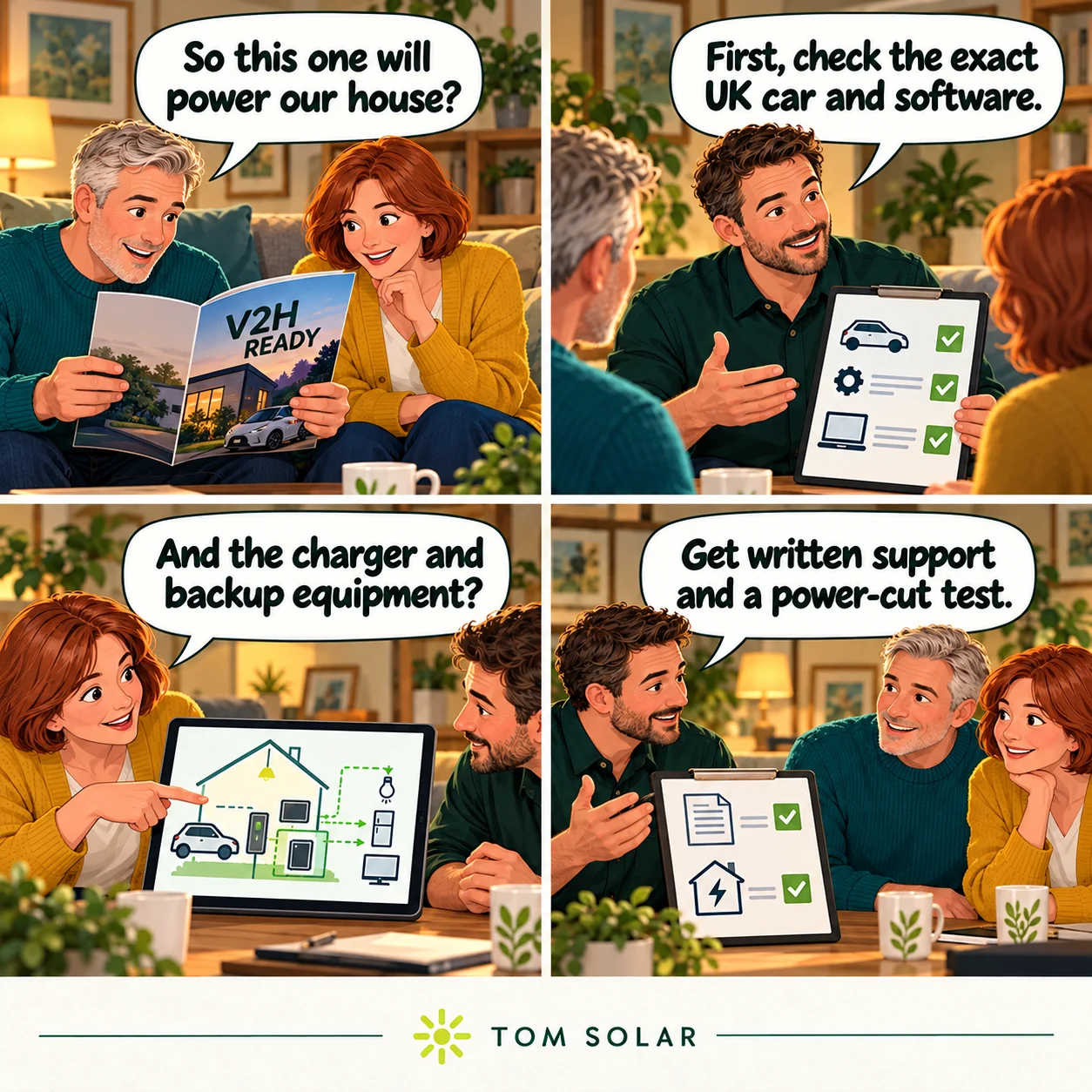
Make backup a written specification before choosing the equipment. “V2H ready” is a starting point for questions, rather than a complete answer.
Compare home battery warranties and learn how to compare complete solar quotations before making a commitment.
The EV offers substantial potential capacity, but it has to be home, plugged in and compatible. A stationary battery is available independently of your driving schedule, although its backup capability also depends on its inverter, switching and installation.
For some households, a stationary battery covering everyday demand and essential backup, with a compatible car extending duration, could be an attractive combination. For others, a simpler stationary system or V2L for a few portable appliances may meet the actual need more economically.
A free initial Tom Solar roof check can start the conversation about solar potential, household demand and future EV plans. It does not certify V2H compatibility; that requires the exact vehicle and proposed electrical design.
Check My Roof FreeNo. The vehicle must support the required discharge function, and the charger, inverter, controls and isolation equipment must form a compatible backup system. An ordinary charging socket or V2G tariff does not establish this.
No. V2L supplies suitable appliances through an outlet. V2H supplies the home through compatible installed equipment. Power-cut backup requires additional provisions to operate safely without the grid.
An illustrative 75 kWh usable battery, starting full, with a 20% driving reserve and 90% conversion efficiency provides 54 kWh to the home. That is about 5.4 days at 10 kWh per day, or 2.7 days at 20 kWh per day. These are estimates, not a system guarantee.
No. A gateway can provide part of the backup arrangement, but cannot create vehicle discharge support or make an ordinary one-way charger bidirectional. The complete combination must be specified and verified.
This guide uses manufacturer documentation and current supplier statements linked beside the relevant claims. The Volkswagen announcement is historical; Kia's cited V2H evidence is for the US; Sigenergy's field tests are independent of vehicle manufacturers. These distinctions are deliberate.
Availability, firmware and supported combinations change. This review does not certify any installation, independently test the equipment or establish an exhaustive UK vehicle compatibility list. Ask for up-to-date written evidence for your own purchase.
Smart charging, solar surplus and vehicle discharge are different capabilities. Compare familiar UK products and specialist bidirectional arrangements in our illustrated EV wall-charger buying guide.