One-way charging
Home → car
Also called unidirectional or monodirectional charging. The charger supplies electricity to the vehicle. Smart scheduling and solar controls can be included without changing that direction.

EV charger buying guide · Solar · Home batteries
One-way charging, smart tariffs, solar surplus and bidirectional backup: similar-looking wall units can do very different jobs. Choose the capability before choosing the box.
Expanded directory: 39 entries · UK product evidence checked: 9 October 2026
Your wall charger sits between the car and the home's electrical supply. It can influence which smart tariff you can use, how surplus solar reaches the car and whether a future bidirectional arrangement would require replacement equipment.
However, buying the most advanced-looking charger is not automatically the best decision. A well-matched one-way charger may do everything you need for years. A specialist bidirectional system can cost substantially more once its required equipment and installation are included.
“What do I want this charger to do today—and what would I regret it being unable to do later?”
Home → car
Also called unidirectional or monodirectional charging. The charger supplies electricity to the vehicle. Smart scheduling and solar controls can be included without changing that direction.
Home / grid ↔ car
The supported arrangement can also discharge the vehicle. The vehicle, equipment, software and permissions must all support the intended use.
Hardware potential ≠ enabled service
A readiness claim may depend on vehicle support, activation or later functionality. Ask what works with your exact car in the UK now, and what remains conditional.
A smart charger can schedule charging, respond to an energy service or monitor demand. Those features manage electricity going into the car. They do not establish an ability to discharge it.
Most familiar domestic wall chargers supply AC; the vehicle's onboard charger converts it for the battery. A DC charger performs conversion outside the vehicle. Bidirectional arrangements can use either architecture, provided the car and equipment support it. “AC” is not another word for one-way, and “DC” is not a guarantee of home backup.
For example, a supported AC bidirectional arrangement relies on suitable vehicle conversion capability. A DC bidirectional system needs compatible discharge communication and external conversion equipment. Buying a connector that fits is only the first check.
Use this directory to identify the capability you need, then compare the exact UK specification. It includes distinct model families, specialist ecosystem options and bidirectional routes. It is not a claim that every entry is available from stock or suitable for every UK home.
Models from the same brand are separated where their design or capability differs. Colour finishes and cable lengths are not counted as extra chargers. The lists are not ranked by quality or price.
39 entries shown
On a phone, swipe each table sideways. Use the search to narrow the list.
These models manage charging into the vehicle. The reviewed sources do not establish vehicle-discharge capability. Some ecosystem products require particular monitoring and inverter equipment; UK stock and regional specification still need checking.
| Model / arrangement | Useful distinction | Before buying |
|---|---|---|
| Ohme Home Pro | Tethered 7.4 kW model with a colour screen, mobile-data connection and smart scheduling. Manufacturer / supplier source | Check tariff integration, cable reach and the required solar-monitoring setup. |
| Ohme ePod | Socketed 7.4 kW model with mobile-data connectivity and app/button control. Manufacturer / supplier source | Include a suitable separate cable; confirm solar setup and exact smart-service eligibility. |
| myenergi zappi | Solar-surplus ECO/ECO+ modes and FAST charging; single- and three-phase variants. Manufacturer / supplier source | Check exact model, sensors and home-battery priorities. |
| myenergi zappi GLO | Compact smart charger with solar-surplus control, scheduling and optional RFID access. Manufacturer / supplier source | Check metering and current supplier integrations. Shared app control of a home battery does not establish vehicle discharge. |
| Hypervolt Home 3 Pro | Boost, Eco (solar/grid) and Super Eco (solar-only) charging modes. Manufacturer / supplier source | Confirm monitoring, connectivity and how the charger interacts with a home battery. |
| Andersen Quartz | Compact model, tethered or socketed, with single- and three-phase configurations. Manufacturer / supplier source | Check solar accessories and the configured power rating. |
| Andersen Quartz Vision | Quartz-style capability with a 4.3-inch charging-information display. Manufacturer / supplier source | Check whether the screen adds value for you; confirm solar metering and configuration. |
| Andersen A3 | 7 kW hidden-cable model with convenience lighting. Manufacturer / supplier source | Check the 5.5 m cable reaches your parking position. |
| Andersen A2 | Hidden-cable model with single- and three-phase options. Manufacturer / supplier source | The manufacturer's comparison limits solar and named tariff integrations to the 7 kW version; check before choosing 22 kW. |
| Wallbox Pulsar Max | Smart AC charging with solar functionality when paired with a suitable Wallbox power meter. Manufacturer / supplier source | Include the meter. This is a different product from Quasar 2. |
| Tesla Wall Connector (UK) | UK wall charger for Tesla and suitable non-Tesla vehicles. Manufacturer / supplier source | Specify UK Type 2 equipment. Pairing with Powerwall does not make this a vehicle-discharge product. |
| Easee One | Compact UK-focused single-phase home model, up to 7.4 kW. Manufacturer / supplier source | Confirm current supply, app, load-management accessories and supplier integration. |
| Easee Charge Max | Home charger with integrated MID metering and display; phase-dependent output. Manufacturer / supplier source | Check UK specification, load-management equipment and whether reimbursement requires the metering feature. |
| Pod / Pod Point Solo 3S | Home charging with app scheduling and solar integration. Manufacturer / supplier source | Check the purchase/service package and included solar monitoring; Pod is the updated brand name. |
| EO Mini Pro 3 | Compact connected home charger with power-balancing capability. Manufacturer / supplier source | Confirm which app/platform and support partner your unit uses; do not assume older EO models have identical support. |
| Simpson & Partners Home Series Basic | Design-led home range with Basic configurations, tethered/socketed and phase options. Manufacturer / supplier source | Ask for the exact Basic specification and required energy-management accessories. |
| Simpson & Partners Home Series Plus | Plus configurations within the Home Series range. Manufacturer / supplier source | Compare the actual feature difference from Basic, not just the finish; confirm sensors and current integrations. |
| Rolec WALLPOD | Domestic/workplace smart AC wall charger, up to 7.4 kW. Manufacturer / supplier source | Specify the current smart variant and app/control package; older WallPod names cover different generations. |
| Rolec ZURA | Rolec's AC charging range also used in domestic and development installations. Manufacturer / supplier source | Check socket count, power and control configuration; avoid paying for site features you do not need. |
| Rolec QUBEV Smart | Home smart-charging option in Rolec's residential/developer range. Manufacturer / supplier source | Ensure the quoted product is QUBEV Smart and obtain its current setup and monitoring specification. |
| waEV-charge EV1i | Tethered model with an attached 5 m cable. Manufacturer / supplier source | Check the app/service supplied and separate requirements for any smart-energy offer. |
| waEV-charge EV1s | Socketed home charger with access-control features. Manufacturer / supplier source | Include a separate cable; confirm app, tariff-service requirements and monitoring. |
| iCS ICS7ET | 7 kW intelligent home charging station in the iCS domestic range. Manufacturer / supplier source | Obtain the current model datasheet, connection options and app/load-management requirements. |
| Project EV APEX 7.3 kW range | Single-phase home-oriented AC range with multiple configurations. Manufacturer / supplier source | Check exact model suffix, socket/cable choice, connectivity and supported solar settings. |
| GivEnergy 7 kW EV Charger | Solar-diverting charger integrating with the GivEnergy ecosystem; charging can draw from solar, grid or a connected home battery. Manufacturer / supplier source | Confirm current UK stock/model and control priorities. Drawing from a home battery is not discharging the car. |
| SMA eCharger | Solar-optimised charging option within SMA's home-energy ecosystem. Manufacturer / supplier source | Confirm the required Sunny Home Manager/equipment pairing, UK supply and phase configuration. |
| SolarEdge ONE EV Charger | Smart solar charging integrated with supported SolarEdge home-energy equipment. Manufacturer / supplier source | Check the compatible inverter, meter and battery combination; do not assume identical functions in older SolarEdge chargers. |
| Fronius Wattpilot Flex Home | Home variant of the Wattpilot Flex solar-charging range. Manufacturer / supplier source | Confirm required energy monitoring, UK installer support and actual phase/output rating. |
| Victron EV Charging Station NS | Integrates with GX/VRM and can charge from surplus solar in a supported Victron installation. Manufacturer / supplier source | Confirm GX integration, UK installation suitability and grid/battery priorities. |
| SolaX X1/X3-EVC | UK-listed smart AC family with 7.2, 11 and 22 kW variants and load balancing. Manufacturer / supplier source | Check generation, exact inverter integration, monitoring and phase requirements. |
| Growatt THOR 07AD | Residential AC family with manufacturer-listed UK-version documentation. Manufacturer / supplier source | Specify exact suffix and UK version, then confirm solar control, monitoring and app requirements. |
| GoodWe HCA G2 | Solar-oriented AC charging family with smart phase switching. Manufacturer / supplier source | Confirm UK stock, regional model, inverter/meter compatibility and commissioning support. |
| Huawei SCharger-7KS-S0 / 22KT-S0 | AC smart-charger family offering a PV-preferred charging mode. Manufacturer / supplier source | Confirm UK availability, supported inverter/meter pairing and regional electrical specification. |
These products carry readiness or V2G/V2H claims. That is worth investigating, but confirm the exact operational UK arrangement before buying for discharge or backup.
| Model / arrangement | Useful distinction | Before buying |
|---|---|---|
| Zaptec Go 2 | UK page describes V2G-ready and solar-ready hardware and advertises V2H/V2G support. Manufacturer / supplier source | Obtain written support for your exact UK vehicle, enabled service and additional equipment. Do not substitute this for the specific Pro combination listed by Octopus. |
| Humax MX7 | Humax launched this UK home range as V2G-ready, with smart charging features. Manufacturer / supplier source | Readiness is not confirmation of an enabled UK discharge service. Check exact model, vehicle support, activation and warranty. |
A specific UK V2G package, a bidirectional product page and an integrated system with independent tests provide different evidence. The checks below explain the distinction.
| Model / arrangement | Useful distinction | Before buying |
|---|---|---|
| V2G-enabled Zaptec Pro + V2G-enabled BYD Dolphin | A specific UK combination currently listed by Octopus for Power Pack. Manufacturer / supplier source | Ordinary Pro/Dolphin versions are not automatically eligible. V2G eligibility does not prove outage backup. |
| Wallbox Quasar 2 | Bidirectional DC product with V2H/V2G described on its UK page. Manufacturer / supplier source | Confirm UK order availability, exact vehicle approval, activation and regional backup equipment. CCS compatibility for charging is not universal discharge support. |
| Sigenergy DC charging module / SigenStor route | Integrated bidirectional home-energy architecture with independent vehicle discharge field tests. Manufacturer / supplier source | Get UK car/year/firmware and warranty support in writing. Sigenergy says its independent tests are not recognised or certified by automakers. |
Listed for context, not as an immediately purchasable backup recommendation.
| Model / arrangement | Useful distinction | Before buying |
|---|---|---|
| Indra bidirectional equipment | Trial/development evidence. Its September 2026 support statement says no market-ready bidirectional charger is currently available. Manufacturer / supplier source | Treat older trials separately from products you can order now. |
Smart-tariff integration is specific to the supplier and equipment combination. Solar charging is not evidence of car discharge. Bidirectional capability is not, by itself, power-cut backup.
Manufacturer sources are linked for each entry. Solar, load-balancing and bidirectional functions can require extra equipment, firmware or activation. Obtain current documentation and a complete installed quote.
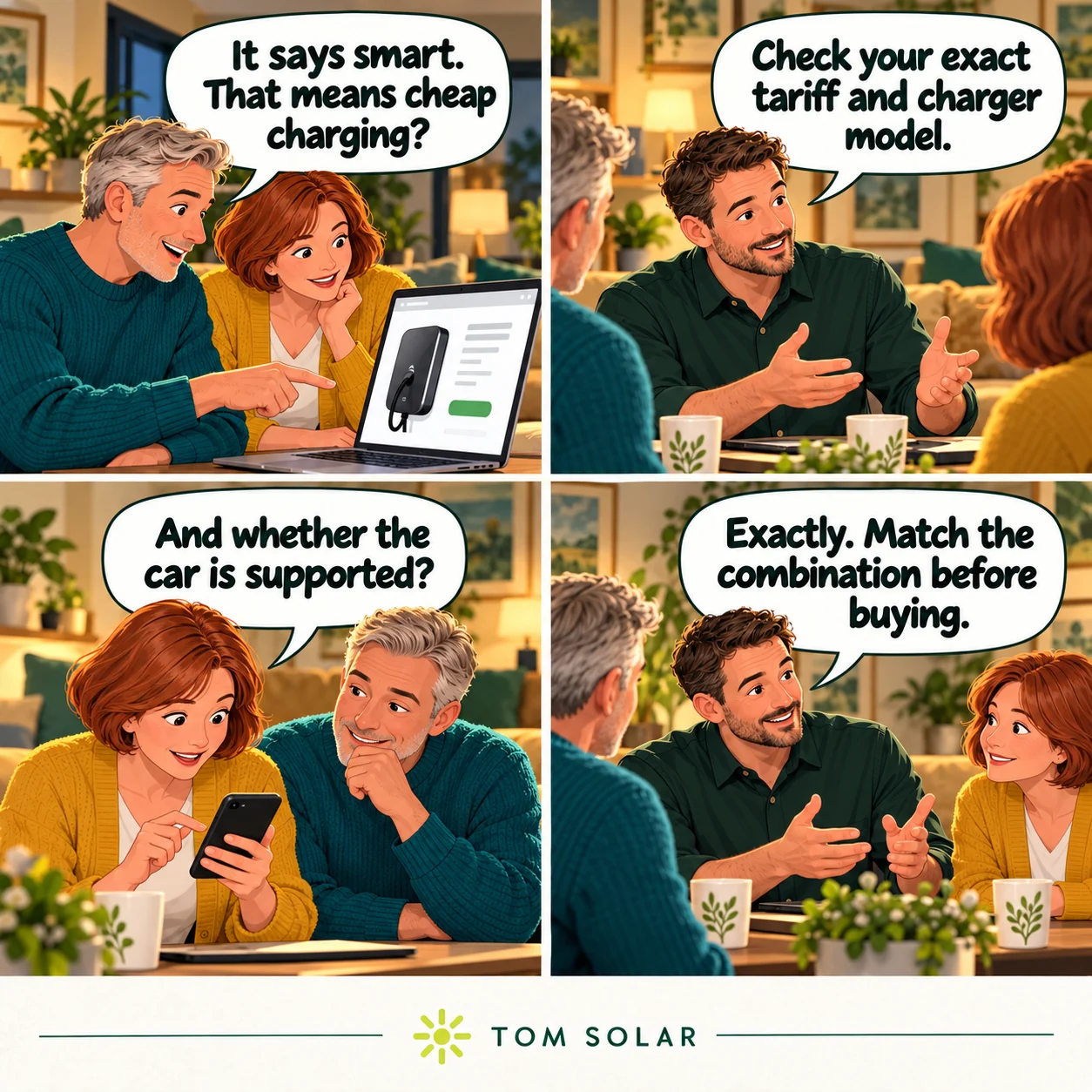
Two chargers can both charge your car perfectly well but have different support from a particular energy supplier. Some smart services control a compatible vehicle directly; others integrate with the charger. Timed off-peak charging and supplier-controlled smart charging are not the same eligibility question.
Use the supplier's current compatibility checker for the exact car/charger combination. Ask what happens if you change supplier, lose connectivity or choose to override a charging schedule. A manufacturer's broad “smart tariff” claim does not replace the supplier's eligibility rules.
Name the charger model, vehicle and intended tariff or service. Ask the installer to distinguish confirmed integration from simply being able to set a timer.
Compare the whole electricity bill, including daytime rates and standing charges, rather than selecting hardware around a single headline overnight price. Charging-window length also matters: see why cheap EV charging windows can fall short.
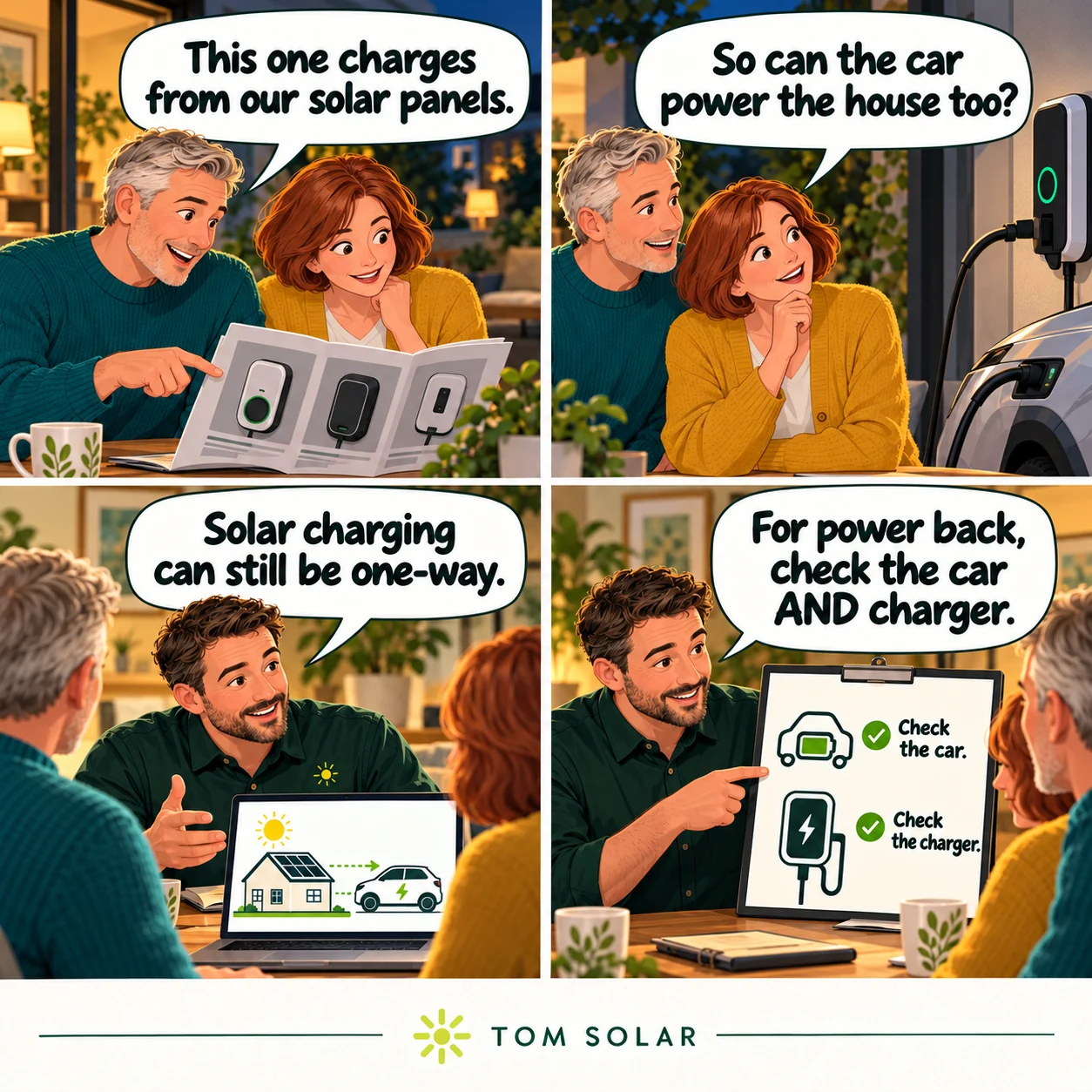
All electricity is shared through the home's electrical system, but a dedicated solar-surplus mode does more than display a sunny icon. It needs an appropriate measurement and control arrangement to adjust vehicle charging as surplus changes.
Ask whether the price includes the required meter or current sensors, how low solar output is handled and whether the charger supplements from the grid. Different charging modes can prioritise reaching your departure target or minimising grid use.
If the home battery and EV charger both react to surplus, establish their priorities. Depending on configuration, the charger may draw energy that the home battery then supplies, unintentionally moving stored household energy into the car.
A good design sets the intended reserve and priorities, checks measurement locations and explains how manual boosts and overnight schedules interact. Do not assume buying all equipment from one brand settles every setting.
A mainstream 32 A single-phase AC installation is around 7.4 kW at 230 V. Typical 11 kW and 22 kW AC charging require three-phase supply, suitable installation and a car capable of accepting that AC rate. An 11 kW onboard charger usually does not deliver 11 kW from a domestic single-phase wall unit.
The vehicle, supply capacity and configured load limit can all reduce the actual rate. Different DC arrangements have different constraints; do not carry the AC three-phase rule across to every DC product.
Compare three-phase supply considerations and solar with an electric vehicle.
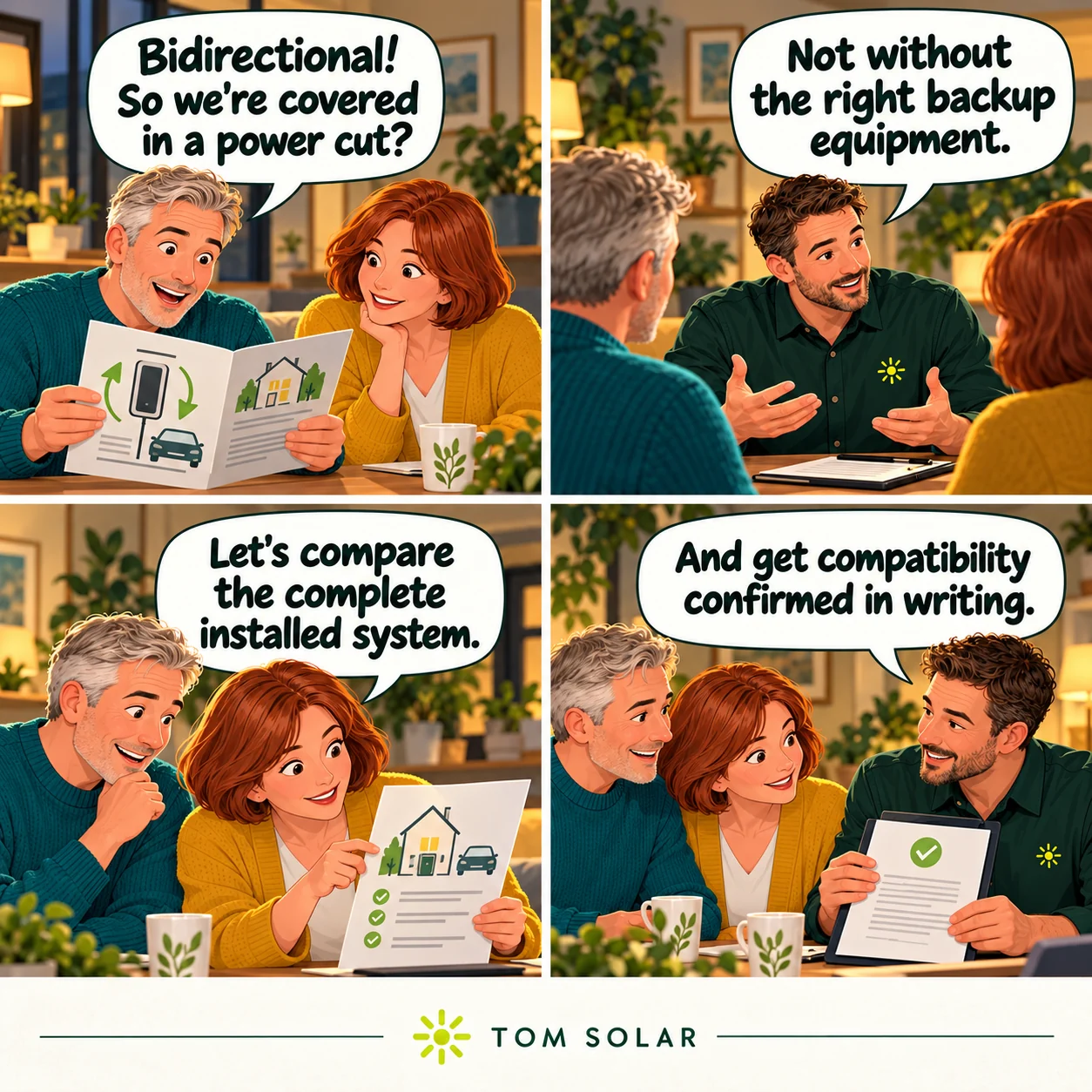
V2G supplies electricity to the public grid. V2H supplies the home through supported equipment. Either term needs a further question: can the system operate when the grid is absent?
For actual backup, the design must safely isolate the home from the network and establish a controlled local supply with suitable protection. Conversion equipment, controls, switching and potentially a stationary battery add to the complete package. The exact requirements depend on the system.
Wallbox's US Quasar 2 material, for instance, states that additional Power Recovery Unit equipment is needed for backup. That is overseas evidence, not a UK equipment specification. Read the US requirements.
A car's separate vehicle-to-load appliance outlet does not make a one-way wall charger bidirectional. Nor should an appliance outlet be connected to a household socket to energise the house.
Our companion guide covers vehicle evidence, isolation, driving reserves and a duration calculator: can my electric car power my house during a power cut?
Request a quotation that separates the charger, solar/load monitoring accessories, installation, any electrical upgrades, and the equipment required for discharge or backup. Add subscriptions and any activation charges that apply to the intended service.
A relatively modest saving on the charger can be outweighed by losing an important integration. Equally, paying a premium for a capability that your vehicle cannot use provides no immediate value.
Installation complexity varies: cable distance, trenching, parking position, supply arrangements and communications can change the bill. A “standard installation” offer needs its included work and exclusions explained.
If your current car cannot discharge and no supported upgrade is available, it may be sensible to fit a good one-way charger now. Ask about cable routes, space and communications that could make later changes easier. Those preparations do not guarantee a future bidirectional system will reuse everything.
Buy bidirectional capability for a supported use you intend to make, rather than an unspecified future feature. A charger that works well today is not a bad purchase simply because more complex technology exists.
For connected generation and storage arrangements, your installer must check applicable network requirements. Read our G98/G99 guide. For the wider buying process, see how to compare solar quotations.
Not necessarily. Solar-surplus charging controls electricity going into the car. Supplying energy back requires a compatible vehicle and bidirectional arrangement.
No. Confirm the exact vehicle, charger, software, activation and UK service. A readiness claim is not a guarantee that the combination can discharge today.
No. Exporting to the grid and operating without it are separate capabilities. Power-cut backup needs a compatible system with isolation, conversion, controls and appropriate electrical protection.
Only if a currently supported capability you need justifies the complete upgrade cost. Check compatibility first; preparing cable routes and equipment space may be more sensible than buying on an uncertain future promise.
Your solar potential, household demand and EV plans belong in the same conversation. A free initial Tom Solar roof check is a useful starting point; final charger compatibility and electrical design need checking against the exact equipment.
Check My Roof FreeManufacturer and supplier sources are linked beside the claims. Products, firmware, regional availability and tariff support can change. The review does not independently test products or certify installations, and it does not rank service quality or financial strength.
Bidirectional-ready hardware, a named UK V2G offer, overseas backup evidence and independent vehicle field tests are kept separate. Ask for current written support and a complete commissioned specification.
Back to the top ↑