Water and food
The official power-cut guidance recommends at least three days’ drinking water—3 litres per person per day—and food that does not need cooking or refrigeration. Include a tin opener, and account for babies, dietary needs and pets.

A practical guide for Scottish homes
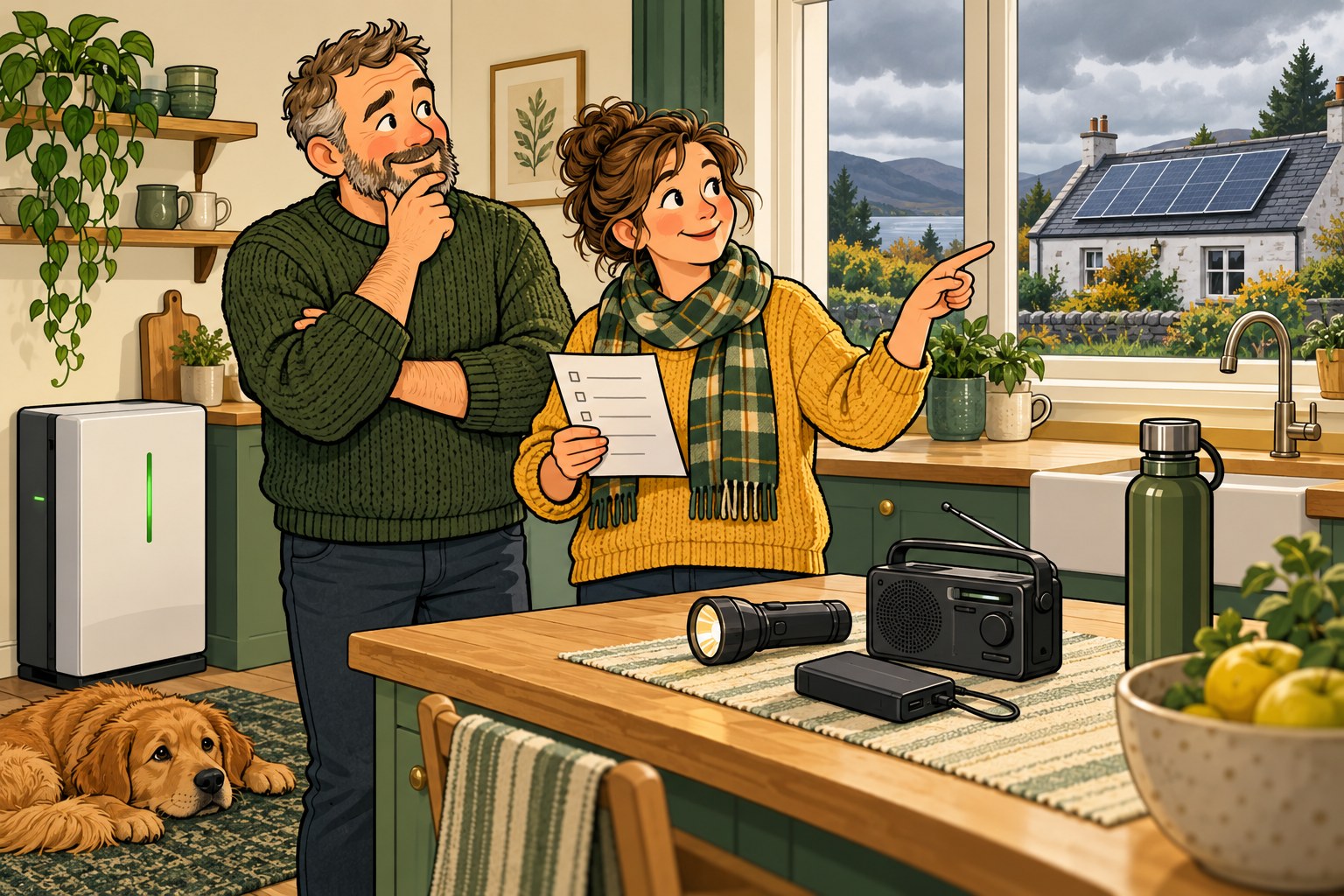
The Government’s “Be Ready” advice asks households to think about how they would manage for up to three days during an emergency. That is sensible general preparation—not a forecast that a blackout is about to happen. And solar panels alone don’t make your house blackout-proof.
First, what does “three days” mean?
The UK Government’s “Be Ready” campaign encourages people to take small, practical steps so they can cope if everyday services are disrupted. Severe weather, a local fault or another emergency can affect electricity, water, mobile service, broadband and payments. The advice is to prepare for a short period while support reaches people who need it most. It is not an announcement that officials expect a nationwide blackout.
Think of it as a household seat belt: you hope you never need it, but having one is a sensible habit. You do not need to turn your spare room into a bunker or buy everything in one dramatic trolley dash. Start with what you already have; add a few useful things when you next shop; tailor the plan to the people and pets in your home.
The useful basics
The official power-cut guidance recommends at least three days’ drinking water—3 litres per person per day—and food that does not need cooking or refrigeration. Include a tin opener, and account for babies, dietary needs and pets.
Keep a torch with spare batteries, a battery or wind-up radio, warm layers and blankets somewhere easy to find. A radio can still deliver updates when the router and television are taking an unscheduled holiday.
Keep a charged power bank, write down key numbers and plan for essential medicines, mobility or medical equipment. Check how any telecare or alarm device behaves during an outage. If eligible, join your supplier’s Priority Services Register.
Also keep a little cash if practical, agree how household members will check in, and think about neighbours who may need a hand. In England, Scotland and Wales, call 105 to report a power cut. If it is safe and you are able, check the relevant network operator for updates.
Why ordinary solar switches off
A typical grid-connected solar inverter constantly checks that the public electricity supply is present and within its safe operating range. When the grid fails, the inverter is designed to disconnect. This is called anti-islanding protection.
Why? When a network operator’s engineers isolate a damaged line so they can inspect or repair it, they need that section to remain safely isolated. If a local generator kept energising an apparently disconnected part of the network, it could create a serious electric-shock risk, interfere with protective equipment, or make the electrical conditions less predictable. Anti-islanding helps stop a home’s solar inverter continuing to feed electricity back towards the wider network.
It is one important protection layer, not a substitute for the network operator’s formal isolation, testing and earthing procedures. Repair crews follow those procedures and do not simply assume a line is dead because the street is dark. But household generation must also be designed so it cannot undermine the safe separation they are working under.
That is why an ordinary grid-tied solar system shuts down during an outage—even on a bright day, and even if the panels look perfectly capable of making electricity. A battery connected to a standard grid-following inverter does not automatically change that behaviour.
What an emergency power setup changes
A system designed for backup uses compatible equipment to disconnect the home’s backup supply from the public grid when the grid is lost. An EPS (Emergency Power Supply) gateway or equivalent transfer arrangement isolates the backed-up circuits before the system supplies them from the battery and, where supported, solar. That local “island” must stay electrically separate from the network.
It is not permission for a home to energise the street, and it is not a DIY switch to add later without a proper design. The inverter, gateway, protection, earthing arrangement and backed-up circuits need to work together and be installed and commissioned by a competent professional. The network operator’s safety systems remain independent.
Some products provide only an emergency socket; some support a selected group of essential circuits; some can support a much larger share of a home. The label “solar and battery” by itself does not tell you which one you have. If you already own a system, check the inverter’s backup specification and ask your installer which sockets or circuits are actually protected. Don’t test it by switching off equipment or opening electrical enclosures yourself.
Could it keep going for 72 hours?
Three days of backup is a design target to assess, not a standard feature or a promise that comes with a battery. The result depends on how much energy is usable, how much power the inverter can deliver at once, what the household actually uses, whether the battery is full when the cut starts, and whether the panels can recharge it while the grid is down.
This is the amount that can be stored and used over time. Decide what must stay on—perhaps lights, communications, refrigeration and a few small appliances—before sizing storage.
This is how much can run at the same moment. Kettles, showers, ovens, immersion heaters, EV charging and electric heating can demand a lot, and may exceed backup output or drain storage quickly.
Panels can help replenish a compatible backup system in daylight, but Scottish winter days are short; cloud, rain, shading, snow and the season all affect output. Treat solar recharge as helpful, not guaranteed.
Some systems also need a specific “black start” or restart capability after the battery has gone flat. Ask how backup begins, what happens if storage reaches its reserve limit, which circuits are covered, and whether solar can recharge during an outage. If resilience matters, put these questions into the design brief before choosing equipment.
A calm household exercise
You do not need to buy solar to follow the Government’s advice. For some households, a torch, radio, water, food and a neighbourly check-in are the right next steps. For others, a well-designed solar-and-battery system may offer useful day-to-day savings and a degree of backup for selected essentials. The fit depends on the home, the budget and the priorities.
The questions worth asking
No. The “Be Ready” campaign is general emergency-preparedness advice. A social post repeating it is not evidence that a specific power cut is planned or expected.
Usually not unless the installation is specifically designed and configured for backup operation. Standard inverters shut down when the grid is lost so they do not continue exporting to the network.
No. The inverter needs backup capability, the home must be safely isolated from the grid, and the supported loads depend on the design. Some systems back up a socket or a few circuits; others can support more.
Possibly for selected low-demand circuits in some conditions, but there is no universal promise. Capacity, battery charge, inverter output, consumption, sunlight and weather all matter.
No. Follow the official household-preparation steps first. A backup-capable solar-and-storage system is one optional part of a wider plan.
Official guidance: UK Government “Be Ready” advice for power cuts. For the system-specific explanation, see Tom Solar’s power-cut guide.
If you’re already exploring solar or storage, include power-cut behaviour in the conversation from the start. A roof check is a useful first step; backup capability, essential circuits and realistic runtime assumptions deserve their own clear answers before you choose a system.
Check My Roof FreeScottish homeowners · No obligation · No sales call required