Product warranty
This covers defects in the physical product or manufacture, subject to the manufacturer's terms and exclusions.
Think of this as: “Is the panel itself defective?”

Solar lifespan and warranties explained
Twenty-five years? Thirty years? Forty?
The confusing part is that warranty length, expected service life and the point at which a panel becomes uneconomic are three completely different things.
The short answer
Solar photovoltaic modules have no engine, gearbox, pump or other rotating machinery.
That is one reason they can remain operational for a very long time.
They do, however, age.
Electrical output normally declines slowly as decades of sunlight, temperature changes, moisture, wind and weather affect the materials.
That distinction is crucial when discussing the real useful life of a solar array.
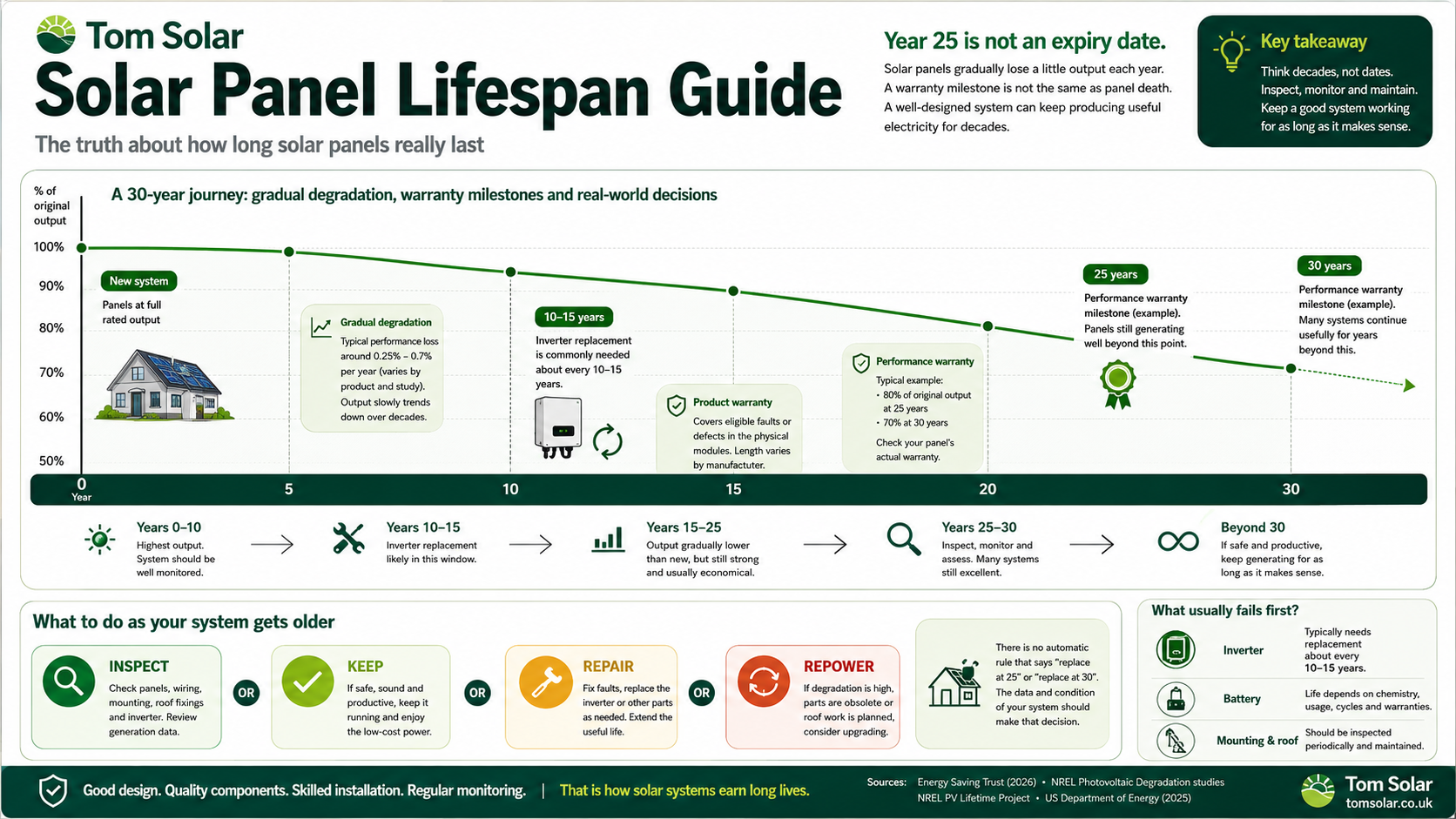
Tom Solar visual guide
The biggest misunderstanding
A warranty is a contractual promise.
A lifespan is how long the physical equipment remains safe and useful.
They are related, but they are not the same thing.
Equally, equipment can sometimes fail during a warranty period.
That is why both product quality and the strength of the warranty provider matter.
Two different warranties
This covers defects in the physical product or manufacture, subject to the manufacturer's terms and exclusions.
Think of this as: “Is the panel itself defective?”
This promises that the panel will retain at least a specified proportion of its original rated output at defined points in time.
Think of this as: “How much power should it still be capable of producing?”
Compare the actual retained-output guarantee, exclusions, claim process, labour coverage, manufacturer backing and who is responsible for replacing a failed module.
Degradation
This gradual loss is known as degradation.
A large NREL review of published field data found a median degradation rate around 0.5% per year across the technologies and systems studied.
More recent NREL field work has shown that some modern module types can perform materially better than that, while others can degrade faster.
The correct figure for a proposed system should come from the specific module's warranted degradation curve and technical data.
What degradation looks like
Imagine a system beginning life with a particular rated capacity.
Over time, each module may become slightly less capable of producing its original maximum power under the same test conditions.
After decades, the system may still retain a substantial majority of its original output.
That is why an older solar array can remain economically useful even though it is no longer performing exactly as it did when new.
What physically ages?
Panels repeatedly heat in sunlight and cool overnight, expanding and contracting materials thousands of times.
Decades of ultraviolet radiation can gradually affect polymers, encapsulants and other materials.
Failed seals or material deterioration can allow moisture to contribute to corrosion and electrical problems.
Wind, snow, transport, installation and roof movement can place repeated mechanical stress on modules.
Microcracks, damaged interconnections and hot spots can reduce module performance or create localised problems.
Connections, connectors, cables and junction boxes are also exposed to years of outdoor operation.
What normally needs replacing first?
The inverter contains far more active electronics than a photovoltaic module.
It continuously converts power, monitors the grid and manages the array.
Energy Saving Trust currently advises homeowners that solar inverters typically need replacement roughly every 10–15 years.
That does not mean every inverter fails at year 10, or survives until year 15. It is a sensible lifecycle cost to recognise.
What about the battery?
A lithium home battery is an electrochemical storage device.
Its ageing process is completely different from a solar panel.
Battery warranties may be expressed using:
Panel, inverter and battery warranties should all be considered separately.
Does year 30 mean replace the roof?
An ageing system should be assessed rather than condemned by calendar.
Useful questions include:
The existing equipment has already been manufactured, transported and installed. Keeping functioning assets productive can have real value.
When replacement can make sense
Repowering an older system may become attractive when several factors come together:
“Your panels are old” by itself is not a particularly sophisticated engineering argument.
Monitoring
Solar output changes naturally from year to year because weather changes.
But long-term monitoring can still reveal unusual performance loss.
Useful comparisons include:
Installation quality matters
Long module warranties are less impressive if the surrounding installation fails prematurely.
The system also relies on:
A superb module cannot compensate for poor workmanship everywhere else.
What should you compare?
| Question | Why it matters |
|---|---|
| How long is the product warranty? | This relates to defects in the physical module. |
| How long is the performance warranty? | This tells you how long the output guarantee runs. |
| What output is actually guaranteed? | Two 30-year warranties can promise different retained performance. |
| Is labour included? | A replacement module is less useful if removal and refitting costs fall entirely on the homeowner. |
| Who stands behind the warranty? | The warranty only has practical value if the responsible manufacturer or provider remains able to honour it. |
| Are there servicing or registration conditions? | Missing required paperwork or maintenance may affect a future claim. |
Buying a house with older solar
When buying a property with an existing array, establish:
A specialist inspection can then assess whether the system remains safe and productive.
Manufacturer strength
Solar warranties extend over unusually long periods.
That makes manufacturer durability relevant.
When comparing products, it is reasonable to consider:
Warranty quality is about backing and terms as well as the number of years printed in large type.
Frequently asked questions
There is no fixed expiry date. Well-made modules are designed for service measured in decades and can remain useful after 25 or 30 years, although output gradually declines.
No. Twenty-five years is commonly a warranty milestone, not an automatic failure date.
It promises a minimum retained electrical-output level over a specified period, subject to the manufacturer's terms.
It covers eligible faults or defects in the physical module for a defined period.
It varies. Historical field research has found central values around 0.5% per year, while some modern module technologies show lower degradation. Use the specific panel's warranted figures when assessing a proposal.
No. The module may continue producing useful electricity for years after its performance-warranty period ends.
Often the inverter. Energy Saving Trust currently gives roughly 10–15 years as a typical replacement interval for domestic solar inverters.
No. Condition, safety and actual performance should determine the decision rather than age alone.
Potential issues include moisture, thermal cycling, UV exposure, corrosion, cell cracking, delamination, electrical faults and severe physical damage.
Long-term monitoring can reveal unexplained changes in output, although normal weather variation must be considered.
Yes. As long as it is generating useful energy safely, it can continue reducing grid imports or earning export income.
Not automatically. Compare the actual terms, degradation promise, product quality, manufacturer backing and installation quality too.
Evidence checked
This homeowner guide was reviewed against current information including:
Degradation and warranty conditions vary substantially between products. Manufacturer datasheets, warranty documents and property-specific inspection findings take precedence over the general examples in this guide.
Related Tom Solar guides
Tom Solar view
Solar is unusual because today's buying decision may still be affecting the property in the 2050s.
That makes chasing the cheapest panel on quotation day a very narrow way to make the decision.
Look at:
The goal is to own a well-designed solar system that is still producing useful electricity many years after the installation invoice has been forgotten.