
TomSolar buyer’s guide · Battery covers & enclosures
Love your battery’s savings. Hate how it looks?
UK battery covers, decorative screens and outdoor cabinets: how to improve the view without compromising the installation.
Your battery may be doing a wonderful job for the household budget while doing very little for the appearance of your home. Perhaps the battery itself is perfectly acceptable, but the inverter, switches and trunking around it create a busy wall. Or perhaps a large grey box now dominates the spot where you used to enjoy looking across the garden.
You do have options. UK suppliers offer made-to-size covers, patterned metal screens and substantial outdoor cabinets. The important distinction is between concealing an existing installation and rebuilding the system inside a different enclosure. The first can be a finishing touch; the second is an installation project.
This is a researched buying guide, not a hands-on product test or a league table of independently certified covers. Prices are examples checked on 10 October 2026. Confirm the current specification, tax, delivery to your postcode and installed price before ordering.
First decide what actually needs improving
Stand back and look at the whole wall. Is it the battery, the cables, the surrounding equipment or the location that bothers you? A cover that hides only the battery might leave the untidy part fully exposed. Conversely, a very large cover can turn a small collection of boxes into an even more imposing feature.
Ask the original installer whether the cable containment or equipment layout can be improved safely before buying anything. Electrical alterations belong with a competent installer. A sympathetic trunking route and a consistent finish may solve the problem without adding a cabinet.
Five options to investigate—not five equivalent products
Our shortlist includes two different Eco-ESS cabinets because they suit different layouts. CommissionIt is a bespoke design route, not a ready-made enclosure we have verified as suitable for your battery. These distinctions matter more than awarding each supplier a number.
1. Battery Covers / Embrace Renewables: conceal the wider installation
The Battery Covers range is designed around made-to-size covers for batteries and inverters. An aluminium frame and lid support cladding, and the supplier describes adjustable rear ventilation and removable access. It is a practical option to investigate when the whole wall needs a more coherent appearance.
Listed examples include an 800 × 675 × 240 mm cover from £364 and a 1400 × 1050 × 355 mm cover from £655. The website says prices include VAT and UK mainland delivery. These are examples, not a promise that either size will accommodate your system. The sizing guidance gives internal dimensions and recommends additional space around the equipment; the battery and inverter manufacturers’ requirements still need to be checked.
Our view: a useful first enquiry for existing outdoor equipment, especially where you want a quieter, less industrial wall. Ask for the precise finish, access arrangement and a dimensioned drawing. Do not treat claims about improved efficiency or longer equipment life as guaranteed savings. Supplier sizing and ventilation FAQs.
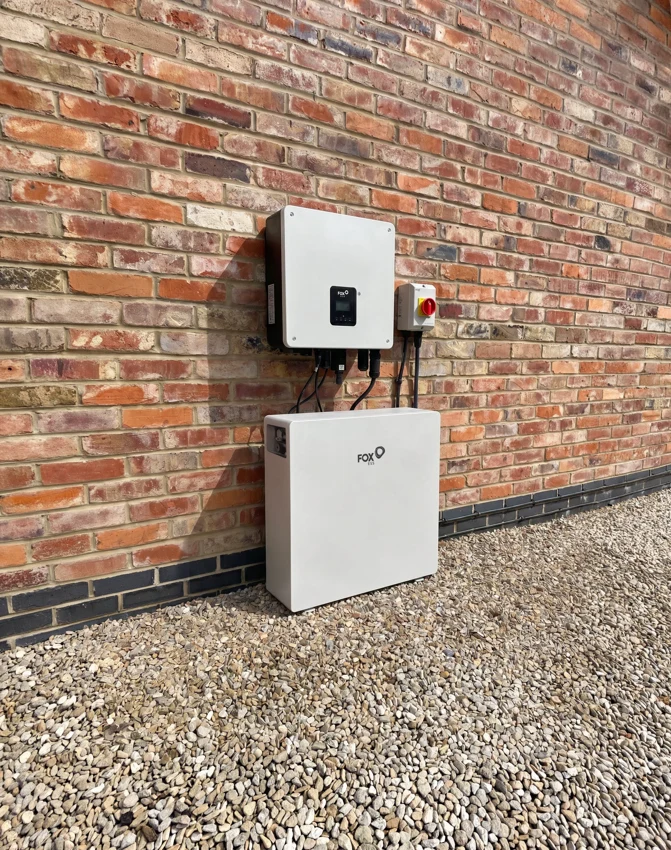
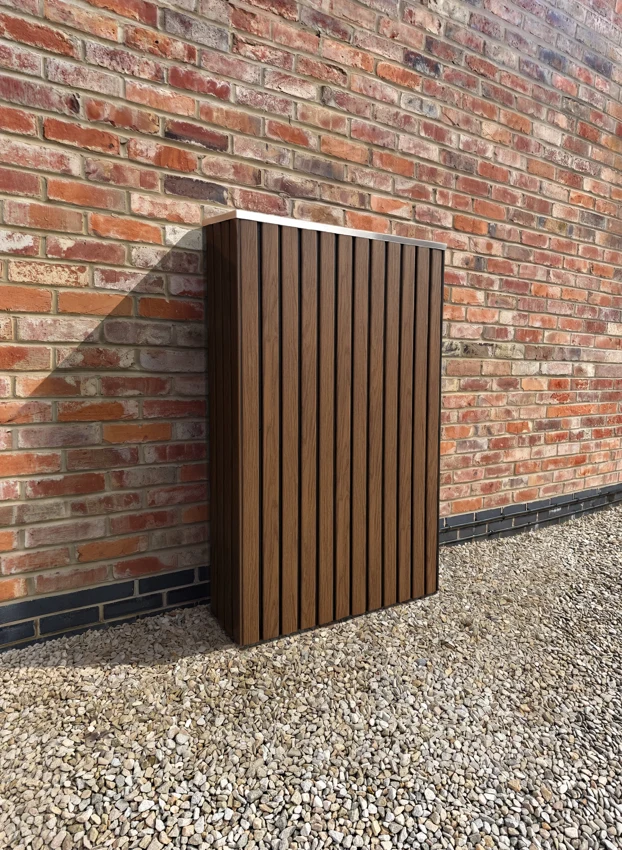
Supplier before-and-after visuals: walnut-finish cover. Not independently audited by TomSolar.
2. Luxury Screens: make the cover a decorative feature
Luxury Screens offers patterned battery covers in powder-coated galvanised steel, with standard colours and bespoke options. This is an alternative for someone who would rather make a feature of the enclosure than have it blend into the wall.
The No.195 listing showed £399–£499, five sizes and wall- or floor-mounted fixing choices. The supplier lists a made-to-order delivery time of three to six weeks. Confirm whether dimensions describe usable internal space, and check the total footprint with the required clearances.
Our view: worth investigating for a garden-facing installation where pattern and colour are important. A perforated panel is not, by itself, proof of sufficient cooling. Marketing references to hallways or indoor rooms do not establish that a battery is permitted in those locations.
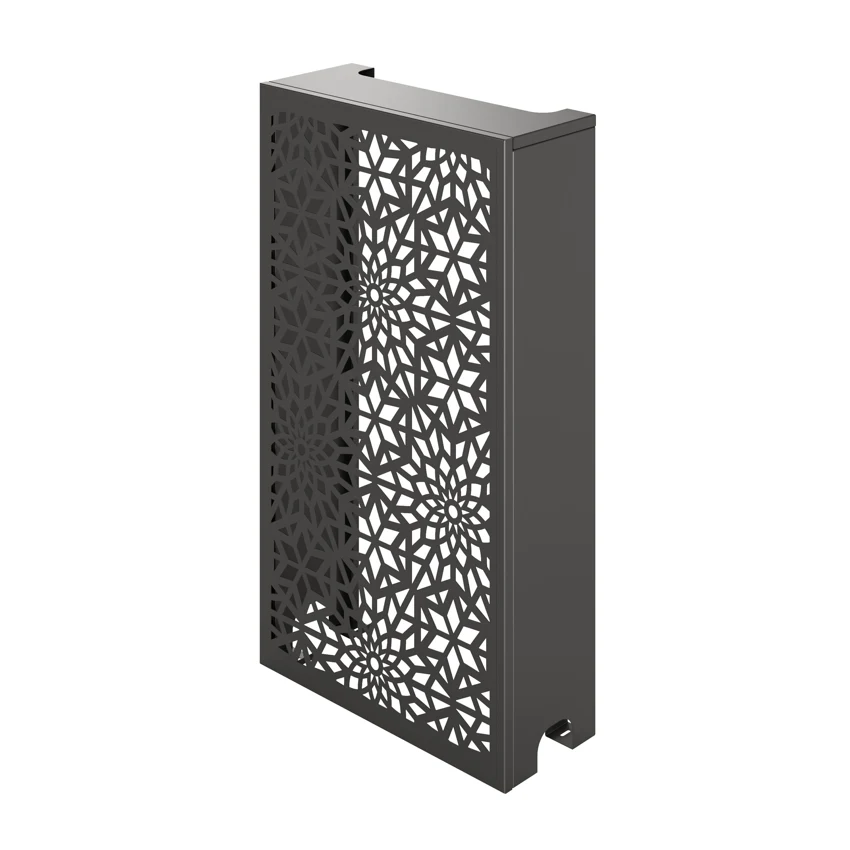
Official No.195 decorative cover visual; not evidence of a complete installation.
3. Eco-ESS Slim 1000: a complete cabinet project
The Eco-ESS outdoor enclosure range is a different proposition. Its Slim 1000 catalogue entry describes a floor-standing cabinet for an inverter and two to four batteries, with thermostatically controlled extraction. The listed dimensions are 1000 mm wide, 450 mm deep and 1900 mm high plus a 100 mm base allowance. Grey powder-coated steel and an optional wood-grain finish are listed.
This is substantial equipment, not a decorative sleeve. Whether existing batteries can be installed inside depends on their exact models, mounting arrangement, cabling and cooling requirements. Obtain a project quotation including any relocation, foundation, electrical work and recommissioning. We did not verify a public retail price for this cabinet.
4. Eco-ESS Standard AIO: a different footprint for a compatible system
The same manufacturer catalogue lists the Standard AIO cabinet, with an 800 mm width, 700 mm depth and 1540 mm height plus 100 mm base allowance. It describes controlled cooling/heating and a grey powder-coated steel finish. The shape may suit a different equipment arrangement from the taller Slim cabinet.
Our view of both Eco-ESS options: investigate them where a properly engineered outdoor cabinet or relocation is needed, rather than choosing one solely to hide a battery. Eco-ESS says it has written compatibility or approval confirmations from several battery and inverter brands. Ask to see the document covering your actual combination; a brand logo is not universal approval for every product.
Fire-resistance claims in the catalogue are conditional on installation guidance and project-specific certification or approval. They must not be interpreted as a guarantee that an enclosed battery system is fireproof.
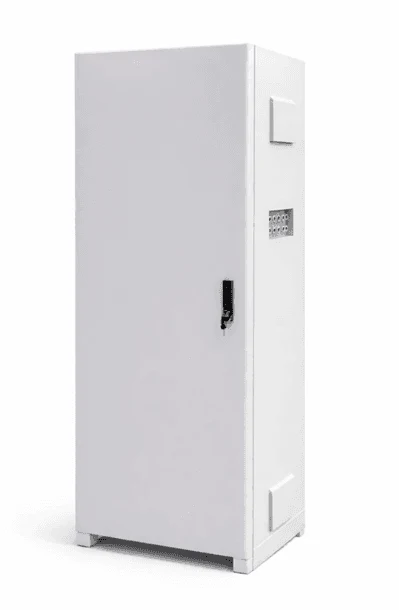
Official Eco-ESS cabinet visual. Confirm the exact model and configuration in your quotation.
5. CommissionIt: a bespoke route, with more verification needed
CommissionIt advertises bespoke battery and inverter covers in timber, composite, aluminium and decorative metal. That may appeal to a homeowner seeking an unusual finish or a design related to the property.
This remains an enquiry option, not our verified product recommendation. Ask for photographs of completed comparable commissions, the named fabricator, technical drawings, material specifications and access details. The electrical installer should approve the proposed arrangement before it is made. Timber or composite styling must not override requirements concerning combustible materials or siting. Obtain a detailed quotation; we have not confirmed a finished, installed price.
Compare the route, not just the price tag
| Option | Starting point | Main question |
|---|---|---|
| Battery Covers | Made-to-size cover around existing equipment | Does the whole layout fit with approved airflow and access? |
| Luxury Screens | Decorative metal cover | Do the pattern, dimensions and fixing arrangement suit this system? |
| Eco-ESS Slim 1000 | Tall complete-system cabinet | Is the exact equipment combination approved and properly integrated? |
| Eco-ESS Standard AIO | Alternative complete-system cabinet footprint | What relocation and electrical work does the design require? |
| CommissionIt | Bespoke design enquiry | Can the fabricator demonstrate a technically suitable completed design? |
The before-you-buy checklist
- Identify everything: record the battery, inverter and gateway models, plus switches, cables and any intended expansion.
- Get written compatibility advice: ask your installer to check the enclosure against the manufacturers’ instructions and confirm any warranty implications. Ask the equipment manufacturer where approval is unclear.
- Preserve cooling: check air inlets, outlets, required gaps and the effect of summer sunshine. Do not add insulation or reduce ventilation on guesswork.
- Keep access usable: doors, removable covers, switches and service space must remain accessible as required. Include how the cover is removed during maintenance.
- Check materials and mounting: account for weight, fixings, combustible materials, wind exposure and a suitable base. This is especially important for a large freestanding cabinet.
- Check the location: an enclosure does not automatically make an unsuitable siting acceptable. Scottish property, planning and installation requirements still apply.
- Ask for the complete price: include delivery to your postcode, assembly, fixing, electrical alterations, relocation and commissioning where needed.
- Ask for real examples: unedited photographs of comparable installations are more useful than an idealised render.
A cover is not a shortcut around installation rules
The Eco-ESS installation manual, September 2026 makes the distinction clear: its enclosure can support an installation aligned with PAS 63100, but the enclosure itself is not “PAS 63100 certified”. The completed system must also follow the applicable wiring requirements and the battery and inverter manufacturers’ instructions. It specifically warns against obstructing vents, door movement or access to isolators.
There is no universal clearance we can safely recommend for every cover and battery. A seller’s suggested gap is not permission to disregard the equipment manual. Likewise, a cabinet does not automatically turn indoor-only equipment into an approved outdoor system.
If equipment is damaged, unusually hot, producing an unusual smell or showing fault warnings, deal with that through the installer rather than concealing it. Never drill into the battery enclosure or alter electrical equipment to fit a decorative cover.
Good-looking equipment—or a good-looking cover?
Before buying a new system, ask to see its complete installed layout. After installation, a suitable cover can be a sensible way to improve the view without replacing functioning equipment. Either way, the best result comes from planning the battery, inverter, switches and cables together.
You do not have to love the look of your battery to love what it does. But you should be able to enjoy your home as well as the savings.
Product details and prices come from the linked suppliers. Images are credited supplier visuals used alongside the review, not proof of an audited installation. No cover has been tested by TomSolar, and no universal warranty, fire-safety or performance endorsement is implied.