
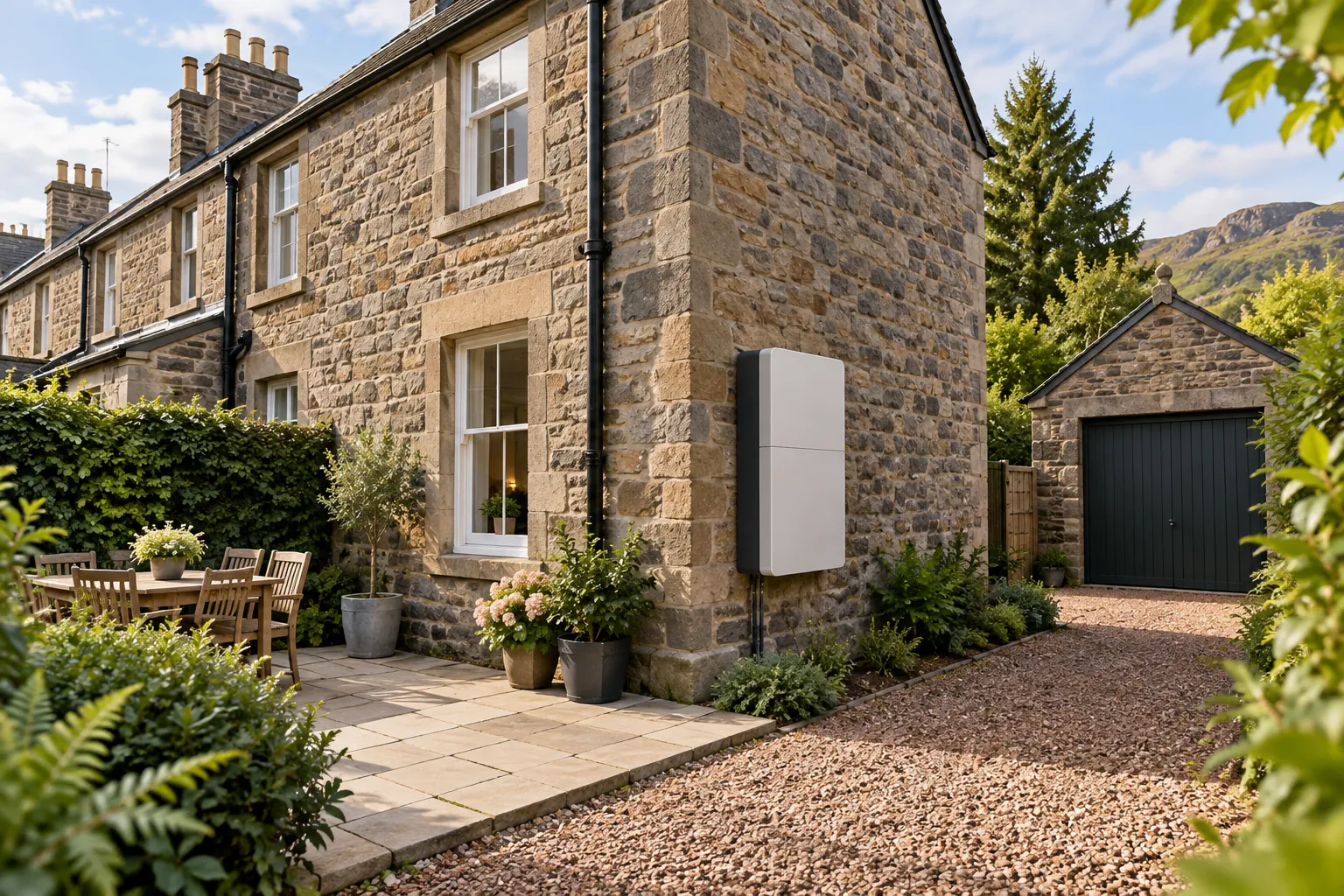
The UK fire-safety specification PAS 63100:2024 prefers outdoor installation where practicable, but it allows an appropriate indoor location when outdoors is impracticable, with ventilation, fire separation and exclusions applied. An outdoor battery must be at least 1 m from doors, windows, ventilation openings and escape routes. PAS 63100 does not state a general 1 m gas-meter rule, nor does it prohibit a front or south-facing wall. Heritage planning restrictions and a manufacturer's temperature limits may nevertheless rule out those positions. Lithium iron phosphate (LFP) does not exempt a battery from the siting rules.
Which document says what?
MCS MIS 3012:2025 is the battery installation standard for MCS contractors. It requires installation to the latest IET Code of Practice for Electrical Energy Storage Systems and applicable BS 7671 requirements. It does not itself print a blanket “outside only” instruction. The IET Code points designers to manufacturer instructions and PAS 63100 for a suitable domestic battery location. PAS 63100 is BSI's fire-safety specification for domestic systems; its stated scope excludes dwellings over 200 m², which calls for a suitable separate assessment rather than an assumption that batteries are forbidden there.
A further change is approaching. BS 7671 Amendment 4:2026 adds a chapter on stationary batteries and refers domestic installations to PAS 63100. The IET says the previous amendment remains valid until 15 October 2026; installers may work to either during the transition. Ask which edition and design standard the installer will certify against. None of this turns MCS certification, planning permission and building regulations into the same thing.
Checking the rules you may have heard
| Claim | What the published documents say |
|---|---|
| “All batteries must be outdoors.” | PAS 63100 says outdoors where practicable. If that is not practicable, it permits suitable indoor locations meeting its ventilation and fire-protection conditions. The installer should record why outdoor installation was impracticable. |
| “Everything must be 1 m away.” | For an outdoor battery, PAS 63100 excludes positions within 1 m of an escape route, door, window or ventilation port. For an indoor battery, the outdoor end of its fresh-air vent must be at least 1 m from doors, windows and vents serving other locations. These are different measurements. |
| “It must be 1 m from gas.” | PAS 63100 does not give a blanket 1 m distance from a gas meter. It excludes batteries within 2 m of stored flammable material and fuel storage tanks or cylinders. A gas service, meter enclosure or boiler still needs a site-specific safety and access check, and another applicable requirement or manufacturer instruction may be more restrictive. |
| “Never on the front or south-facing wall.” | No compass-direction ban or universal frontage ban appears in PAS 63100. Exterior wall fire performance, openings, impact risk, weather and the manufacturer's permitted temperature and sunlight exposure matter. Planning or listed-building controls can also affect a visible frontage. |
| “LFP is safe enough to ignore the distances.” | LFP is a lithium-ion chemistry often associated with improved thermal stability compared with nickel-rich chemistries. It can still fail and produce hazardous heat and gases. PAS 63100 does not carve out an LFP exception. |
Where can an indoor battery go?
A suitable utility room, an appropriate garage or a properly designed outbuilding may be possible. The answer depends on the actual room, construction and battery. PAS 63100 requires fresh-air ventilation to outside for all indoor battery locations, with any necessary fire separation from excluded spaces; the cited separation is at least 30 minutes. It prohibits batteries in bedrooms and other rooms intended for sleep; corridors, stairs and other escape routes; cupboards opening into sleeping rooms; lofts, roof voids and inaccessible basements; and within 2 m of stored flammables or fuel tanks/cylinders.
For an infrequently visited location such as a store cupboard, PAS 63100 calls for an interlinked smoke or multi-sensor alarm in that location. Its notes recommend appropriate detection across the home. A cupboard is not automatically approved just because an alarm is installed: escape, ventilation, construction and manufacturer requirements still apply. A garage also needs protection from vehicle impact where relevant. Under the PAS, an individual battery enclosure is limited to 20 kWh; the total is generally 40 kWh indoors, or 80 kWh in qualifying outdoor or garage/outbuilding locations. Larger and unusual systems demand a different design assessment.
What about LFP and a sunny wall?
LFP's chemistry is a useful safety improvement, but system safety also depends on cell quality, enclosure, battery management, protective devices and correct installation. It is still covered as lithium-ion under the cited standards. A south-facing wall could expose equipment to intense sun and heat, particularly behind a dark enclosure; whether it is acceptable is decided by the product's stated operating and installation conditions and the site's actual exposure. Shade or a suitable enclosure may help if approved by the manufacturer. There is no MCS compass rule to quote as a universal prohibition.
Listed buildings and conservation areas in Scotland
These are separate from battery fire safety. On a listed building, external fixings, cable holes, internal changes and a battery enclosure can affect the building's special character. Historic Environment Scotland advises obtaining listed building consent before changes that affect that character and checking with the planning authority even for seemingly small alterations. A detached outbuilding within the curtilage may also raise heritage and planning questions. Listed does not mean “no battery”, but written advice and any necessary consent should come before drilling or ordering equipment.
In a conservation area, an externally visible battery may affect the protected streetscape. Permission depends on the work, appearance, site and local controls, including any removed permitted development rights. Scottish householder guidance restricts solar panels on a principal or road-facing side elevation in a conservation area. That rule is not, by itself, a universal legal ban on batteries on every front wall. Ask the planning authority to assess the battery and associated cabling as proposed; a less visible side, rear or outbuilding location may be easier to justify. Internal placement might avoid the visual issue but still has to satisfy fire and ventilation requirements.
The Scottish Government's March 2026 planning guidance for large battery storage projects concerns generating stations and megawatt thresholds. It should not be used as a domestic battery installation checklist.
Are building regulations different in Scotland?
Yes, the building-control systems differ. England and Wales have Building Regulations and Part P guidance for domestic electrical work, with notification requirements depending on the work and nation. Scotland uses the Building (Scotland) Regulations, domestic technical handbook and local-authority building-warrant system instead of English Part P. The current Scottish domestic handbook applies to work from 6 April 2026. A warrant may be needed for associated building work, and work exempt from a warrant must still satisfy applicable building standards. Northern Ireland has its own system. The electrician should identify the precise electrical, fire-stopping, wall penetration, structural and notification or warrant requirements for the proposed job; there is no single UK building-regulation sentence saying “all home batteries outside”.
Planning permission, listed building consent, a building warrant and electrical certification answer different questions. An installer should check each relevant route, plus the DNO connection rules and any leaseholder or insurer requirements. An MCS certificate does not grant planning permission.
Can a home be unsuitable for a battery?
Yes. A narrow terrace might have doors and windows along every usable external wall, no suitable rear garden or outbuilding, and no indoor room that can be ventilated and separated appropriately. A listed interior or conservation frontage might rule out otherwise promising changes. Product dimensions, temperature limits, impact exposure or landlord consent can close the remaining options. Do not put the battery in a prohibited loft or escape route merely to make the sale work.
That does not stop the homeowner installing solar panels without a battery, where the roof and other permissions permit it. It may be better to export surplus generation and revisit storage if a safe, lawful location becomes available. A reputable installer should be willing to say “no suitable battery location” after a documented survey.
What to ask for on a survey
- Show me a proposed position on a photo or plan, with dimensions to every door, window, vent, escape route and any fuel storage.
- Which clause of PAS 63100 or manufacturer instruction applies to each clearance, and what is the basis for any gas-meter or sun-exposure distance?
- If indoors, where does the fresh-air ventilation terminate, what fire separation and detection are needed, and why is outdoors impracticable?
- For a listed building or conservation area, what written planning advice and consents are required? Does a Scottish building warrant or English/Welsh building-control notification apply?
- Will the installation be documented against the chosen BS 7671 edition, MIS 3012 and manufacturer instructions?
This is a reading of the published national documents as at 27 September 2026. A site survey, current product instructions and the relevant authority's decision determine an individual installation.
Primary documents
- BSI: PAS 63100:2024, especially sections 6.5 and 6.6.
- MCS: Battery Installation Standard MIS 3012:2025.
- IET: BS 7671 Amendment 4 and transition date; IET: new battery chapter.
- Historic Environment Scotland: listed building and conservation consent; Scottish householder permitted development guidance.
- UK Government technical research: comparative LFP and metal-oxide battery fire behaviour.
- Scottish domestic technical handbook, April 2026; England: Approved Document P; Wales: Approved Document P.
Have an awkward location?
Start with the property, not a promise that every battery can go anywhere. A roof check can establish whether solar is worthwhile; battery siting needs a proper installer survey before it is specified.
Check my roof free